
Your new superintendent can read drawings and spot poor workmanship. But Monday's coordination meeting still ends with vague assurances, and Thursday brings another crew waiting for access. Construction superintendent training needs to address that gap: turning a schedule into work that crews can actually deliver.
Technical knowledge matters. So does knowing how to run a planning conversation without supplying every answer yourself. The Last Planner® System (LPS), a collaborative production planning system, gives you a framework for practicing those skills alongside your existing safety and management training.
Construction superintendent training needs assessed field practice
Say, in a hypothetical Columbus, Ohio, project, a foreman becomes superintendent on a four-story medical office building with 14 trade partners. He's good at directing his own crew. Coordinating decisions across those companies is a different responsibility.
The U.S. Bureau of Labor Statistics (2026), in its Occupational Outlook Handbook entry for construction managers, describes planning, coordination, budgeting, and supervision. It says newly hired managers typically train under an experienced manager for up to one year, sometimes longer. That supports a mentored approach, although the occupational category is broader than superintendent.
The handbook's first-line supervisor entry, BLS (2026), lists direct supervision and coordination, with a high school diploma or equivalent and five years or more of related experience as typical preparation. These are occupational descriptions, not universal hiring rules. Wikipedia (2026), “Superintendent (construction)”, identifies daily site operations and short-term scheduling as superintendent responsibilities.
Your curriculum should cover safety, drawings, quality control, logistics, cost awareness, contracts, documentation, scheduling, and closeout. Foreman training needs crew-level application; superintendent training needs cross-trade decisions and escalation. Neither should end at a knowledge quiz.
Before enrolling, compare the syllabus with your role and experience. Check credential eligibility separately from course admission. Self-paced study is easier to fit around work, but you'll still need coached practice; classroom sessions offer discussion but require time away. Budget for assessment and follow-up, not tuition alone. A certificate can document learning. It can't demonstrate how you'll handle an unrealistic promise.
Safety training stays separate. OSHA (2024), Outreach Training Program Requirements, says Outreach training is voluntary federally, isn't certification, and doesn't satisfy training requirements in OSHA standards. Some jurisdictions and employers require it. Your safety lead should identify the requirements that apply to your work.
Rehearse collaboration before testing it on the project
A superintendent who dominates a practice meeting may repeat that behavior on site. Give the team a shared experience first, so foremen can challenge a planning decision without arguing about someone's past project.
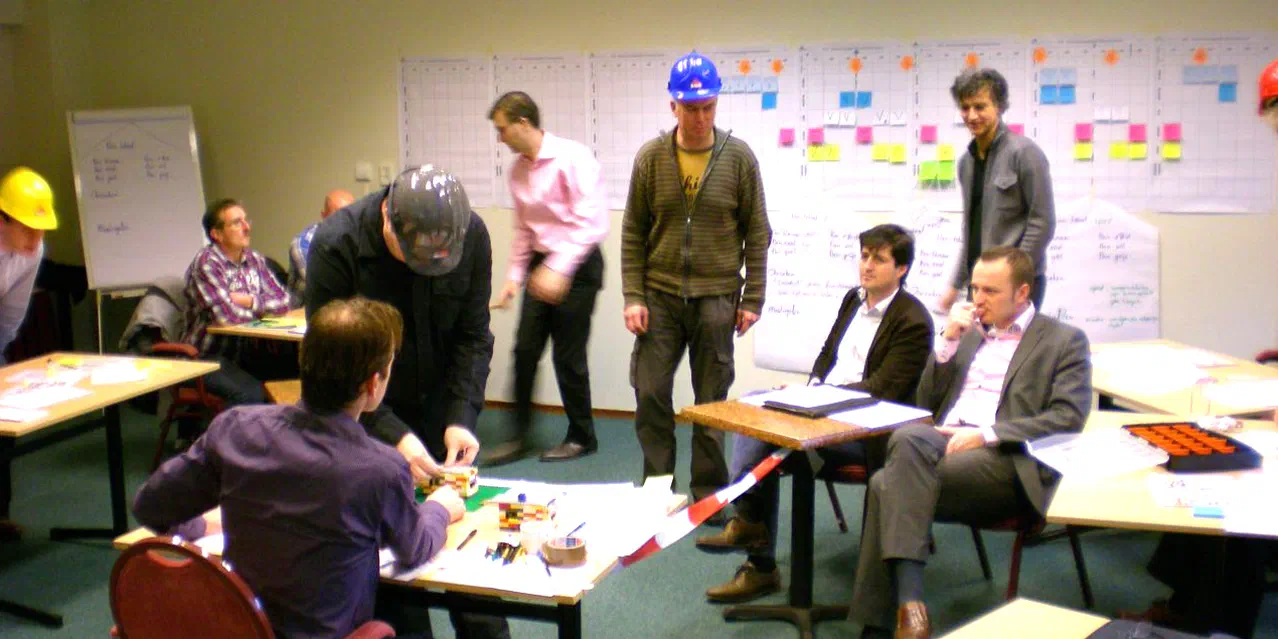
Villego® is a Last Planner System simulation in which a project team builds a small house, or “villa,” from small bricks in two rounds: first the usual push way, then the Last Planner way. Observers record construction time, waste, safety, productivity, and PPC, or Percent Plan Complete, the share of planned commitments completed as agreed.
Use the debrief to connect a specific missed handoff, the transfer of completed work to another trade, with a better planning conversation. Ask what information would've changed the team's decision. Don't let the discussion stop at which round finished faster.
Warcup and Reeve (2014) reported that 19 of 25 questionnaire respondents, 76%, identified communication, collaboration, teamwork, and commitment as learning outcomes. Their small qualitative study doesn't establish field productivity gains. Participants also needed further learning to implement LPS fully.
That's the right expectation. A simulation starts the learning; mentored work tests whether it transfers.
Learn to facilitate a pull planning session
In the Columbus example, the team writes “inspection complete” on the wall, but nobody agrees which rooms must be ready. A neat board won't fix that ambiguity. Pull planning works backward from a milestone to identify the work and handoffs needed to reach it.
Mossman (2015) describes collaborative planning from the future, with the next trade's requirements shaping preceding work. Your training exercise should make those requirements explicit.
Choose one phase, such as closing walls on one floor. Agree what “ready for closure” means with the relevant foremen, quality staff, and inspection coordination lead. Then ask the receiving trade what it needs, where, and by when. Work backward through each predecessor rather than assigning dates yourself.
Let foremen explain their durations. Ask about crew capacity and shared equipment. If two trades need the same corridor, help them negotiate a sequence; don't quietly move a note after they've agreed.
Finally, walk the sequence forward to test access, inspections, and missing steps. Compare the agreed sequence with the project schedule, recording any conflict for escalation before anybody promises a milestone the current plan can't support. You'll find a fuller meeting structure in the pull planning session guide.
The mentor should watch your facilitation. Did the foremen negotiate directly? Were assumptions recorded? A colorful wall isn't evidence of either.
Make work ready before securing a promise
A foreman says, “We'll finish the overhead rough-in Friday.” In our hypothetical project, the approved detail is missing and a lift is booked elsewhere. You haven't secured a reliable commitment, even if everyone nods.
Make-ready means removing the conditions that prevent work from being performed. Train yourself to screen upcoming tasks for approved information, materials, equipment, capable crews, access, completed predecessor work, inspections, and safe working conditions. Long-lead items need attention before they enter the short-term planning window.
A constraint is a specific obstacle to delivery. “Design issue” isn't specific enough. Record the unanswered detail, affected location, responsible person, needed-by date, and evidence that will confirm resolution in your constraint analysis process. The superintendent needn't solve every issue personally, but should ensure someone accepts responsibility and escalate before the deadline slips.
Then practice both sides of the promise conversation. As requester, you clarify the required result, location, deadline, and acceptance criteria. As performer, the foreman checks readiness and capacity before accepting, declining, or offering a different date.
Mossman (2015) emphasizes the freedom to say no. A pressured yes hides information you need. You shouldn't count a tentative phase-planning date as a ready weekly commitment.
For example, replace “rough-in Friday” with a defined area, specified scope, and a deadline the receiving trade can use. Record that commitment in the weekly work plan. When conditions change, the foreman should notify affected trades early and negotiate recovery. Keep the original commitment visible.
Train foremen to act as last planners
A foreman who attends every meeting may still leave planning to the superintendent. Attendance isn't participation. A last planner is the person close enough to production, with authority over the crew's work, to make a meaningful commitment.
Your construction foreman training should let that person practice describing a workable assignment, checking capacity, requesting a handoff, and raising a constraint. Start with a real task. Have the foreman explain it to the next trade, then ask the receiver to describe what they'll accept. You'll hear mismatched assumptions quickly.
Jay Facemire, Project Superintendent, Turner Construction Co., describes the value of a shared introduction in a testimonial on the Villego simulation page:
I personally like the Villego simulation used as a part of John Draper's/Lean Project Consultant's boot camp format because Villego helps general foreman quickly understand the Last Planner System (LPS) and gets them all engaged in using the full Last Planner System on our project. I think everyone understands the concepts for production planning sooner and begin using new behaviors and processes sooner than when we start up the Last Planner System without running the Villego simulation.
That's a practitioner's testimonial, not a measured training effect. Follow the introduction with observation on site. When a foreman struggles, ask what would let the next crew start safely. Don't answer for them immediately. And if their employer hasn't delegated commitment authority, resolve that first; training can't supply authority they don't have.
A 90-day training plan for a new superintendent
Without protected practice time, a new superintendent's development becomes whatever yesterday's emergency happened to teach. The following is a proposed training plan, not a certification standard. Use one manageable phase and an experienced mentor, keeping existing safety and contract responsibilities intact.
- Days 1–15: establish the baseline. Review role boundaries with the project manager and safety lead. Shadow planning meetings and walk handoffs with foremen. Record current commitments, completion results, and recurring blockers without changing definitions. Each week, the mentor reviews a meeting and walks a handoff with you to connect the discussion with what happened at the workface. You'll learn which problems training can address and which need management decisions.
- Days 16–30: rehearse and co-facilitate. Complete a simulation with the participating foremen, then co-lead one bounded phase pull plan. Practice requesting and making promises. Draft acceptance criteria for actual handoffs, and have receiving trades confirm them. The mentor gives feedback on questions, listening, and unsupported assumptions rather than presentation polish.
- Days 31–60: run the weekly cycle. Lead make-ready reviews and weekly commitment meetings. Maintain constraint ownership, verify closures at the workface, and check changing conditions in daily coordination. Coach individual foremen using their assignments. Review one missed commitment with the mentor each week and test a countermeasure, a specific change intended to prevent recurrence.
- Days 61–90: demonstrate independent delivery. Facilitate the next phase plan while the mentor observes without directing it. Explain PPC and recurring reasons for misses. Show whether countermeasures helped, and how planned handoffs support the milestone. Agree further coaching needs using this evidence; don't declare competence because the calendar reached day 90.
Reserve coaching time in advance. You'll need project-manager support to clear issues outside your authority, or the plan becomes another obligation without the means to deliver it.
Measure reliability alongside actual progress
Suppose the Columbus team completes 18 of 24 weekly commitments as agreed. Its PPC is 18 ÷ 24 × 100 = 75%. That measures commitment reliability, not physical percent complete or labor productivity. Each assignment counts once, regardless of size.
Review the Percent Plan Complete measure with the foremen each week. Keep assignment definitions consistent, retain missed commitments, and record reasons for variance, the explanations for differences between promised and actual delivery. Partial completion doesn't earn full credit under a completion-as-agreed rule.
Track constraint closures against their needed-by dates too, with evidence rather than verbal assurances. Watch for repeated misses caused by the same unresolved prerequisite. If inspection readiness keeps failing, investigate the specific handoff and test a change; “inspectors” is too broad to guide action.
You'll also need milestone movement, installed quantities, rework, and safety information. High PPC with too little necessary work completed can still leave the project late. Don't reward promises that hide delay.
Compare the early baseline with later weeks, noting changes in scope and crew availability. The mentor's assessment should also record whether foremen negotiate handoffs, decline unready work, and warn others early. Those behaviors help explain the numbers. They don't prove that training caused every improvement.
A superintendent is ready when foremen can plan without being rescued
If your superintendent still writes every trade's commitments after 90 days, the team remains dependent on one person. That dependence will show up when they're absent or busy elsewhere.
The practical test is a planning cycle foremen can own: clear requests, ready work, honest promises, and useful learning from misses. Keep coaching where that cycle breaks. Course completion is a starting point; demonstrated planning behavior is the evidence you're looking for.
Sources
- U.S. Bureau of Labor Statistics (2026). Construction Managers.
- U.S. Bureau of Labor Statistics (2026). Data for Occupations Not Covered in Detail.
- Wikipedia (2026). Superintendent (construction).
- Occupational Safety and Health Administration (2024). Outreach Training Program Requirements.
- Robert Warcup and Edward Reeve (2014). Using the Villego® Simulation to Teach the Last Planner® System.
- Alan Mossman (2015). Last Planner®: 5 + 1 crucial & collaborative conversations for predictable design & construction delivery.
- Villego (2025). How the Villego lean simulation works.