
Your schedule says drywall starts Monday. Above-ceiling inspections aren't complete, a delivery blocks the access route, and the foreman doesn't know which rooms are released. Everyone has work assigned. Nobody has a dependable handoff.
Lean construction principles help you change those conditions before asking crews to work faster. They connect what the owner needs with how information, materials and finished work move through the project. This guide translates each principle into a site practice and a matching method, so you can decide what should change on Monday morning.
What is lean construction when the schedule meets the workface?
Say a general contractor in Columbus, Ohio, is building a four-story medical office with 14 trade partners. This hypothetical project looks healthy on its progress report because rough-in quantities are rising. Yet the ceiling crew keeps moving between rooms that aren't ready. Local progress is hiding a project-wide delay.
Lean construction is an approach to designing and managing project production that increases customer value while reducing wasted effort and unreliable flow. It covers design and supply as well as installation. The Wikipedia entry on lean construction describes that end-to-end scope; it's broader than housekeeping or a new scheduling format.
Koskela (1992), in Application of the New Production Philosophy to Construction, CIFE Technical Report 72 at Stanford, challenged the conventional conceptual basis of construction. His later transformation-flow-value view gives you complementary ways to examine production. Koskela, Rooke, Bertelsen and Henrich (2007) explain those interdependent perspectives in The TFV Theory of Production: New Developments:
- Transformation: Does the crew convert inputs into the required output, such as installed ductwork?
- Flow: Where does work wait between transformations?
- Value: Does the completed work meet the customer's needs, including operation and maintenance?
You need all these views. Efficient duct installation can't compensate for inaccessible dampers or a blocked ceiling inspection. Howell (1999), in What Is Lean Construction - 1999, argues for managing interactions between activities and the combined effects of dependence and variation. Optimizing each trade separately won't necessarily optimize the project.
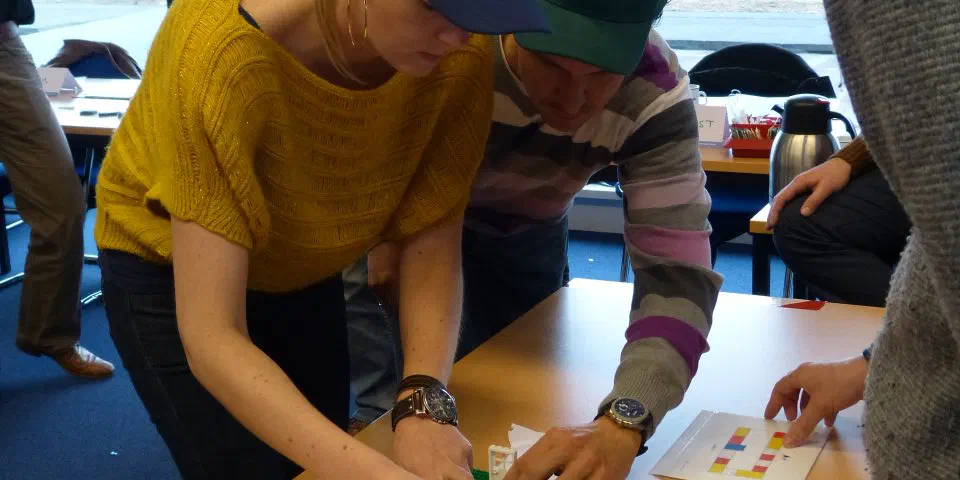
That shift can be difficult to explain through slides. Villego® is a hands-on Last Planner® System simulation in which a project team builds a small house, or villa, from small bricks in two rounds: first the usual push way, then the Last Planner way. Observers record construction time, waste, safety, productivity and Percent Plan Complete (PPC), the share of planned commitments completed as promised. Comparing rounds gives the team a shared example of how production decisions affect other trades.
Warcup and Reeve (2014), in Using the Villego® Simulation to Teach the Last Planner® System, report that 19 of 25 respondents, or 76%, identified communication, collaboration, teamwork and commitment as takeaways. That's evidence about learning in a small study, not a forecast of your project's savings. Participants also needed further learning to implement LPS fully.
Five lean construction principles, translated into site practices
A superintendent hears five principles at one training and six tenets at another. Labels alone won't release a room. Use the frameworks to examine decisions, rather than treat them as competing checklists.
Womack and Jones (1996), in Lean Thinking: Banish Waste and Create Wealth in Your Corporation, describe value, value stream, flow, pull and perfection. The Wikipedia overview of lean thinking lists the same five. In projects, respect for people and optimizing the whole make these principles workable. Respect must reach the workface.
1. Value: agree on what a useful completion looks like
On our hypothetical medical office, the owner needs examination rooms ready for equipment installation. The drywall foreman needs inspected rough-in before closure. If your team calls both requirements “finish the floor,” people can meet their individual targets while missing the owner's actual need.
Start Monday's coordination with a specific acceptance discussion. What must be true for a room to be usable by the next crew, and how does that handoff support the owner's opening date? Record conditions of satisfaction, meaning the agreed criteria for acceptable work. Your room-release criteria might require signed inspection approval, completed backing and a marked route for equipment access.
The matching method is the Last Planner System's shared planning and commitments. It lets the people responsible for delivering and receiving work agree on what completion means. A promise with observable acceptance criteria is easier to plan around than “mostly finished.” Don't substitute a foreman's agreement for the architect's specifications or an inspector's approval.
Value decisions also reach back into design. Invite the operator and relevant trade partners to review maintenance access before installation. Target value design means steering design choices within an agreed cost target while protecting required function. On site, you can support that intent by raising conflicts early; you can't authorize an unapproved redesign to save installation time.
2. Value stream: follow one handoff beyond your own trade
The electrical crew finishes its installation, then waits for a test record to reach the inspection coordinator. The installation took hours. The information handoff takes days. Looking only at labor productivity would miss the blockage.
Choose one repeated output, such as a room ready for ceiling closure. Map its steps from approved information through material delivery, installation, inspection and acceptance. Include queues and decisions. Your map should show who receives each output, not just who performs the activity.
The matching practice is a gemba walk, a visit to the place where work happens to observe the actual process with the people doing it. Ask the foreman to show you a completed room, including the information that released it and any equipment or access problems the crew faced along the way. This view of construction productivity through reliable work prevents you from treating every interruption as a crew-speed problem.
A short 5S trial can address problems the walk reveals: sort, set in order, shine, standardize and sustain. For example, assign labeled locations for current drawings and test equipment, then have the crew check whether they remain usable each morning. Organization has to support the work. A spotless storage cabinet doesn't help if the needed tester is still locked inside it.
3. Flow: release smaller, complete areas
On the Columbus example, rough-in crews spread across eight similar rooms before inviting inspection. The ceiling crew can't use their partial progress. Work in process, meaning started work that hasn't reached an accepted handoff, keeps growing.
Consider a deliberately simplified calculation. Assume one rough-in crew takes two working days per room, works sequentially, and an inspection takes one further working day per released batch. An eight-room batch makes its first accepted release after 8 × 2 + 1 = 17 working days. A two-room batch makes its first release after 2 × 2 + 1 = 5 working days, or 17 − 5 = 12 working days earlier.
This isn't a claim that the project finishes 12 days sooner. It compares first-handoff timing at the same installation rate. Smaller batches require more inspection visits, and later releases depend on inspector availability. Check that capacity before changing the batch size.
The matching method is takt planning for repeated work areas, which coordinates trades around an agreed rhythm through zones. On Monday, compare each trade's workload in one proposed zone before promising a common pace. A larger mechanical workload may require a different zone boundary or added capacity. Takt works best where repetition is sufficient and prerequisites are dependable; irregular work needs a different treatment.
Flow isn't maximum crew utilization everywhere. Sometimes helping a predecessor clear one complete area produces a better project result than opening another unfinished room.
4. Pull: start work because a downstream need is ready
A date on the master schedule triggers a bulk drywall delivery, but overhead work remains incomplete. The material consumes access space and needs moving twice. Starting early has made the next handoff harder.
Pull means downstream need governs upstream production or release. For our hypothetical rooms, work backward from the equipment-installation milestone and ask each receiving trade what it needs from its predecessor. The matching method is pull planning around agreed handoffs. You can establish the required sequence without assuming that everything is ready today.
That distinction matters on Monday. A backward plan describes what should happen; release into production still needs a readiness check. Make-ready work removes constraints, the missing prerequisites that prevent an assignment from being completed. Check approved information, materials, safe access, predecessor completion and crew capacity before a last planner makes a promise. A last planner is the person close enough to the work, with authority, to commit the crew's effort.
Pull doesn't mean ordering every material at the last possible moment. Long-lead equipment needs advance procurement. Coordinate its production and delivery with genuine project requirements, then use justified protection against supply uncertainty. An empty laydown area doesn't prove success.
5. Perfection: test a countermeasure and check the result
The room-release meeting ends with “we'll communicate better.” Next week, another inspection request arrives too late. A vague lesson hasn't changed the process that created the miss.
Treat perfection as a direction for continuous improvement, not a demand for error-free people. On Monday, choose one recurring reason for variance, meaning a reason an actual result differed from the commitment. Describe the actual miss with those involved. Then check the evidence together. Blaming electrical won't explain an inspection failure.
The matching tools are an A3 and root cause analysis that leads to a countermeasure. An A3 is a concise problem-solving account that records the current condition and supporting evidence, explains the cause, describes the proposed change, and assigns responsibility for checking what happens after the trial. You might discover that inspection requests lack a named sender and an agreed readiness signal. The proposed change would assign that responsibility and make the signal visible.
You'll need to test the explanation. Asking “why” repeatedly can produce guesses if nobody checks the records or observes the work. Compare the next room batch with the previous process, then retain or adjust the change. Set a date to check the countermeasure. That completes the learning step in a plan-do-check-act cycle.
PPC helps you find broken promises, but it doesn't measure installed quantity or owner value. Keep the completion definition stable. Otherwise, breaking assignments into easy fragments can improve the score while delaying a useful handoff.
Respect for people means crews can say the work isn't ready
Suppose the drywall foreman spots unfinished firestopping but expects criticism for refusing Monday's start. The issue stays quiet until the ceiling has to come down. Your planning system has rewarded silence.
Respect for people changes that response. The superintendent can ask what would make the work safe and ready, listen to the answer, and help remove the blockage. Foremen need authority to decline an unsound commitment without being labeled uncooperative. They also need clear responsibility for keeping the commitments they do make.
This doesn't remove accountability. It makes accountability usable. On a gemba walk, ask “What stops you completing this room?” rather than “Why aren't you keeping up?” Then close the loop on the issue the crew raises. If you don't act on valid concerns, your next conversation will contain less useful information.
Include the receiving trade in acceptance decisions and let craft workers propose better setups. Explain how the agreed improvement affects their work. A rule developed with the crew is more likely to fit the physical task than one written without seeing it.
And protect safe work explicitly. Flow never justifies skipping an inspection, bypassing fall protection or crowding incompatible operations into the same zone. A lean label doesn't change your safety duties.
Find the seven wastes without removing necessary protection
A dumpster count won't reveal the foreman's walk to find a drawing or the room waiting for approval. Waste includes time and effort, not just discarded materials.
Wikipedia's Muda (Japanese term) entry explains waste in lean thinking and lists the original seven forms associated with the Toyota Production System. The following are hypothetical site examples, with a first response you can examine during your walk.
| Original waste | Site example | Practice to test |
|---|---|---|
| Transportation | Moving the same pallet between laydown areas | Agree on point-of-use delivery and access |
| Inventory | Rooms partly installed but unavailable to the next trade | Limit open work and complete handoffs |
| Motion | Walking back to the trailer for each drawing check | Apply 5S to workface information and tools |
| Waiting | A crew stands by for inspection release | Confirm readiness and inspection capacity together |
| Overproduction | Installing ceilings before overhead work is accepted | Release work against downstream need |
| Overprocessing | Entering the same status into separate reports | Agree on a shared information source |
| Defects | Removing work installed to an outdated detail | Verify current information before starting |
Unused talent is a common later addition, not one of the original seven. Your craft workers' knowledge belongs in the improvement process.
Don't label every non-installation minute waste you can delete. Inspections, required documentation and safe setup may not transform the building, but they provide necessary protection. Improve how they're performed; don't remove their purpose. Likewise, a planned buffer can protect flow when uncertainty remains. The test is whether the activity is necessary and proportionate to the risk, not whether it looks busy.
Variability needs active control, not a tighter promise
If room-release dates change daily, a ceiling crew must either wait or move elsewhere. The electrical crew then returns to a crowded room. Those adjustments create further variation, even when each foreman is acting sensibly for their own trade.
Howell's 1999 paper makes dependence and variation a central production concern. Work duration varies, deliveries arrive unevenly, and design responses don't always match your forecast. Each handoff carries that uncertainty downstream. Writing a shorter duration on the plan won't control its cause.
Separate preventable variation from uncertainty you still have to manage. Standardize a repeatable inspection request, verify room boundaries and clear missing information before work starts. For remaining uncertainty, choose a visible buffer: time before a milestone, some available capacity, or a small stock of a supply-critical item. Each costs something. Explain which disruption it protects against.
A workable backlog is a set of ready alternative assignments that crews can use when planned work becomes blocked. It should support the agreed sequence, not become permission to start anywhere. In our hypothetical medical office, an inspected room in the next zone may be a useful alternative; an uncoordinated room awaiting design clarification isn't.
Watch completion dates by location and track why releases move. If a trade repeatedly needs longer than the proposed takt, reconsider work content and capacity. Don't pressure the crew to hide the mismatch.
Choose lean construction tools by the problem they solve
A project buys planning software and installs a large board, yet Monday's crews still lack approved information. The tools display the problem without changing who resolves it.
Lean construction methods work when their use changes a decision or a behavior. A3 helps investigate a recurring miss. Takt coordinates repeated zones. LPS supports dependable commitments. Gemba walks reveal actual conditions, and 5S supports an orderly workface. These lean construction techniques can reinforce each other, but you don't need to introduce them all at once.
Start with one repeated handoff and enough time for several learning cycles. Budget time for facilitation and crew participation, and explain what authority participants have. Resistance may reflect a real commercial concern: a trade carrying extra coordination cost won't accept “the whole project benefits” as payment. Resolve scope and compensation through the proper agreement.
Lean in construction can be practiced under conventional contracts. Integrated project delivery can support it by aligning participants through shared commercial arrangements, but a contract alone doesn't make a poor assignment ready. Bring designers and suppliers into the conversation early where their decisions affect production.
Technology is useful when it keeps agreed information current and visible to the people who need it. A model can help check spatial conflicts; a shared log can identify an unresolved prerequisite and its responsible person. Neither proves the workface is ready. Keep that verification close to the work.
Measure the outcome alongside plan reliability. Earlier accepted handoffs may reduce waiting and rework, supporting cost and schedule performance. Check quality and safety too. These are improvements to verify locally, not guaranteed returns from adopting a label.
Monday's test is a ready handoff that someone can accept
Another Monday meeting can end with a revised date and no change in the room. That's the failure these principles should prevent.
Choose a handoff tied to your milestone. Your team can test its readiness with these questions before anyone commits a crew to start:
- What will the receiving trade accept?
- What is still missing, who will remove it, and by when?
- Is the producing crew's capacity sufficient?
- What will you examine if the handoff doesn't happen as promised?
You don't need to wait for a complete lean rollout to ask those questions. But you'll need to act on the answers. If nobody changes the release decision, removes a constraint or checks a countermeasure, the meeting hasn't improved production.
The practical test of lean construction is a complete, safe handoff that the next crew can use. Make that dependable, then improve the next one.
Sources
- Wikipedia (2026). Lean construction.
- Lauri Koskela (1992). Application of the New Production Philosophy to Construction.
- Lauri Koskela, John Rooke, Sven Bertelsen and Guilherme Henrich (2007). The TFV Theory of Production: New Developments.
- Gregory A. Howell (1999). What Is Lean Construction - 1999.
- Robert Warcup and Edward Reeve (2014). Using the Villego® Simulation to Teach the Last Planner® System.
- James P. Womack and Daniel T. Jones (1996). Lean Thinking: Banish Waste and Create Wealth in Your Corporation.
- Wikipedia (2026). Muda (Japanese term).