
Your drywall crew arrives Monday because the schedule says it should. The electrician still needs access inside the walls, and the inspection hasn't happened. Everybody has a start date. Nobody has agreed what the next crew needs before it can work.
Pull planning addresses that gap by working backward from a milestone and negotiating the handoffs that make it possible. Each trade asks, “What do you need from me, and when, so you can start?” The answer includes a finished piece of work, its location and the conditions the receiving trade will accept.
A useful pull plan makes those agreements visible. This guide explains how to build one, test whether it fits the available time and keep it connected to the work crews actually perform.
What is pull planning in construction?
A note saying “mechanical complete” doesn't tell the ceiling contractor whether it can close an area. Does complete include testing? Has the inspector accepted the installation? You can't coordinate that handoff with a duration alone.
Pull planning is a collaborative method for defining and sequencing work backward from an agreed milestone, using the needs of downstream trades to determine upstream work. In construction, the people supervising production help build the sequence. A last planner is someone close enough to the work, often a foreman, to judge crew capacity and prerequisites.
Ballard (2000), in Phase Scheduling, explains that backward planning defines tasks whose completion releases work to others. His phase schedules connect master-schedule milestones with the lookahead process. That's the practical test: who can start because you've finished?
This conversation takes practice. Villego® is a hands-on Last Planner® System simulation in which a project team builds a small house, or “villa,” from small bricks in two rounds: first the usual push way, then the Last Planner way. Observers record construction time, waste, safety, productivity and PPC, or Percent Plan Complete, the share of planned tasks completed. It gives teams a shared setting for practicing handoff negotiations without experimenting on installed work.
Warcup and Reeve (2014), in their independent simulation study, describe participants getting stuck when planning backward; inviting the preceding planner to agree a handoff with the receiving planner helped them proceed. The paper also cautions that one simulation doesn't provide all the knowledge needed for implementation.
On your project, pull planning normally addresses a defined phase, such as enclosure or an interior turnover, rather than every detail of the whole job. It's one conversation within the Last Planner System. The phase plan describes what should happen; make-ready and weekly planning establish what can happen and what crews will commit to doing.
Push and pull differ in what authorizes the work
Say your flooring subcontractor delivers material because its scheduled installation date has arrived. The slab hasn't met the specified moisture condition, and pallets now block an access route. Starting earlier hasn't helped the next operation. It has created work in process and another handling problem.
Wikipedia's Push–pull strategy article, accessed in 2026, distinguishes production in anticipation of demand from production responding to expressed demand. Definitions also vary with work-in-process limits. For a construction team, the useful distinction is how downstream needs affect upstream decisions.
With schedule push, a planned date becomes the reason to mobilize even when the workface isn't ready. With pull, the receiving operation states what it needs, and the team arranges upstream production and deliveries to satisfy that need. The date still matters. But it doesn't remove the need to check readiness.
A backward pass alone won't create pull. If the superintendent assigns every duration while foremen watch, you've reversed the order of scheduling without negotiating production. Trades need room to challenge prerequisites and offer alternatives.
Nor does pull planning replace the critical path method, or CPM. You can reconcile the agreed phase logic with the project's CPM schedule to test milestone effects and contractual dates. CPM can calculate backward too. The distinction is the trade conversation and the control of work release, not which direction you read a chart.
Define a handoff the receiving trade can accept
Imagine a painter accepting “walls ready” and discovering unfinished corners behind casework. The drywall foreman thought the main wall surfaces were enough. Both acted on different definitions of done.
A handoff is the transfer of completed work, access or information that enables another party's work. Conditions of satisfaction are the agreed criteria for accepting that transfer. They describe what the receiver needs, where it needs it and by when. “Done” becomes something both sides can check.
Mossman (2020), in his guide to collaborative production planning, emphasizes shared understanding of those conditions. He describes the performing last planner declaring completion and the receiving party assessing whether the conditions have been met.
You can turn a vague handoff into a usable agreement: “All walls in rooms 201–206 are finished to the specified level, dry enough for the selected coating, inspected by the drywall foreman and cleared of sanding equipment by Tuesday's end of shift.” The painter confirms the surfaces and access before releasing its crew.
It's worth separating scope completion from acceptance. A crew can finish installing while an inspection or test remains outstanding. Include the inspection as work with an owner, rather than assuming it happens between notes.
The receiver should state the minimum workable release. Does it need the entire floor, or can it start in an accepted group of rooms? Smaller releases can reduce waiting, provided they don't create unsafe overlap, extra mobilizations or incomplete systems that cannot be tested. You'll need the trades' judgment here.
Prepare a bounded phase with credible inputs
A group asked to plan “all interiors” may spend its time arguing about rooms that aren't yet designed. A narrower boundary gives people something they can assess. For example, plan the second-floor east wing from accepted framing through an agreed turnover state.
Preparation starts with a precise milestone. “Ready for owner equipment installation” needs a scope and acceptance criteria, not just a Friday date. You should also identify the earliest practical start, interim releases and interfaces with adjoining phases. Otherwise the team may build a sequence that depends on unavailable access.
The right participants are the people who can explain methods and commit resources, supported by whoever can resolve design, logistics or inspection questions. A subcontractor's project manager may know staffing commitments; its foreman knows what fits in the room. You'll sometimes need both.
Before the conversation, trades should bring quantities, expected crew sizes, necessary approvals and durations under stated working conditions. Don't ask them to guess under pressure. A duration based on one crew cannot silently become a promise for several workfaces.
Known long-lead dependencies belong in the inputs too. If switchgear procurement extends beyond the phase, it still controls what that phase can deliver. Waiting until the lookahead to discover it is too late.
Your facilitator can circulate the milestone, drawings and unresolved assumptions in advance, giving each trade time to check its proposed method. That lets the meeting focus on decisions rather than document searches. The separate guide to a pull planning session covers the agenda, room and facilitation roles in detail.
Run the conversation backward, then test it forward
A wall full of notes can hide a missing dependency. The painter points to drywall, the drywall foreman points to rough-in, and nobody has included the inspection. Working through the receiving trade's needs brings that gap into the discussion.
A short procedure keeps the conversation useful:
- Agree the milestone's acceptance state. Name who receives the finished phase and what evidence confirms completion.
- Ask the final performer what releases its work. Record the required handoff and connect it to the predecessor. Continue backward through every necessary branch.
- Add durations and resource assumptions. Distinguish working time from required waiting, such as curing, and from uncertainty allowance.
- Read the plan forward. Check that releases, access, shared equipment and crew commitments allow the sequence to happen.
- Test the dates and record decisions. Identify the driving chain, unresolved constraints, buffer placement and the people responsible for follow-up.
The question remains the same at every link: “What do you need from me, and when, so you can start?” A task may have several suppliers. Wall closure might need electrical, plumbing and mechanical releases, plus inspection acceptance. Don't reduce that to one misleading arrow.
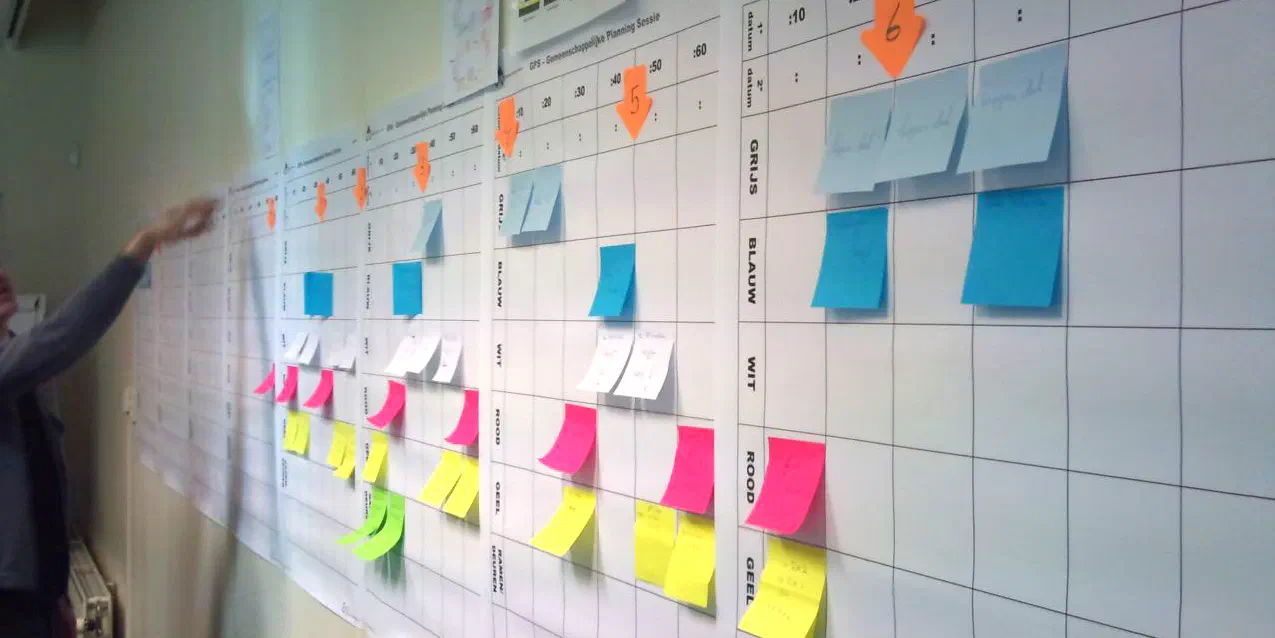
Sticky note conventions should help people read the logic. Use a consistent color per trade and include task, location, duration, owner and the handoff that releases it. Agree whether a note marks a start or a finish. There's no universal color rule; your pull planning sticky notes convention needs a visible legend.
Paper and digital boards can both support the work. A digital version helps distribute revisions, but moving notes on a screen won't repair an unclear agreement. Capture dependencies and conditions alongside dates so the published plan doesn't lose the conversation.
A worked pull plan with dates and durations
Say a general contractor in Columbus, Ohio, is planning six exam rooms in a hypothetical four-story medical office building. Framing can start on Monday, October 5, 2026. The milestone is an accepted room turnover at the end of Friday, October 30.
For this example, every Monday through Friday is a working day, including October 12; weekends aren't. There are no other closures. That gives four weeks × five working days = 20 working days. Durations below are illustrative, not production standards, and required drying time remains within the stated wall-finishing and painting methods.
The acceptance lead needs one day after completed trim and checks. The trim crews need accepted painted rooms; the painter needs accepted wall finishes; wall closure needs coordinated rough-in and inspection approval. Framing releases rough-in. The trades agree that each handoff is available by the end of its final working day, so the receiver starts the next working day.
The first sequence doesn't fit. Its allowances are framing 2 days, rough-in 5, inspection 1, wall closure and finishing 6, painting 3, trim 2, shared buffer 2 and acceptance 1. The working is 2 + 5 + 1 + 6 + 3 + 2 + 2 + 1 = 22 working days. The gap is 22 − 20 = 2 working days. Those numbers assume the stages are serial; parallel branches would require a network calculation instead of adding every task.
Here's the revised sequence after two method changes:
| Activity or allowance | Working days | Dates in 2026 | Required release or acceptance |
|---|---|---|---|
| Framing | 2 | Oct. 5–6 | Correct layouts, completed framing and usable access |
| Coordinated rough-in | 4 | Oct. 7–12 | Each system ready for the agreed inspection |
| Inspection | 1 | Oct. 13 | Required approvals recorded before wall closure |
| Wall closure and finishing | 5 | Oct. 14–20 | Specified finishes ready for the selected coating |
| Painting | 3 | Oct. 21–23 | Coating ready for trim without damage |
| Trim and trade checks | 2 | Oct. 26–27 | Completed installations and required check records |
| Shared schedule buffer | 2 | Oct. 28–29 | Visible allowance for agreed production risks |
| Joint acceptance and turnover | 1 | Oct. 30 | Agreed room conditions accepted and recorded |
The revised working is 2 + 4 + 1 + 5 + 3 + 2 + 2 + 1 = 20 working days. The milestone fits, but only if the method changes and prerequisites hold. A calendar match isn't readiness.
An inspection failure on October 13 would affect wall closure. That's why the inspection booking and acceptance criteria need confirmation before rough-in starts. The buffer gives the team room to respond; it doesn't guarantee that any corrective work will fit.
When the pull plan is longer than the milestone allows
In the example, deleting the two-day buffer would make the original sequence fit on paper. It would also remove the agreed protection without improving production. That's a poor first response.
Ballard (2000) recommends estimating durations without hidden contingency, testing logic and methods, then deliberately allocating available schedule contingency. If the available gap cannot absorb the expected variability, the team must replan or address the completion date. A crowded board isn't evidence that acceleration is feasible.
Which dependencies are genuinely necessary? Does the painter need every room finished before starting? Could the inspection authority accept a defined smaller release? Such changes work only when the parties agree the acceptance boundaries and resulting visits. Overlapping incompatible work in one room won't help.
In this hypothetical plan, the rough-in trades agree to move cutting and assembly preparation outside the rooms. With coordinated access and unchanged installation requirements, they judge that rough-in can fall from five working days to four. The drywall trade then agrees to release finished room groups to its own following crew, reducing wall closure and finishing from six days to five without shortening required drying time.
Those are method changes, not demands to work faster. The assumed savings need validation against quantities and crew capacity before anyone relies on them. You'd also check the preparation space and whether work shifted outside the phase has been scheduled, rather than treating that preparation as work that happens for free.
More workers or overtime may be another option, but you can't assume a linear duration reduction. Congestion, supervision limits and restricted inspection hours can defeat it. Shortening a task away from the driving chain may save cost without advancing the milestone.
A remaining gap needs prompt escalation. The decision-maker needs the evidence and feasible options. Revised scope or a different turnover sequence needs the appropriate approvals; moving a contractual milestone needs formal agreement. Foremen shouldn't be pressured into promises they can't keep.
Make buffers visible and give them a purpose
If every trade hides an extra day inside its duration, you can't see where protection sits or which uncertainty it addresses. If you remove every allowance, one failed inspection can consume time the receiving crews were counting on. Both approaches weaken the discussion.
A buffer is a deliberate allowance that protects flow or a milestone against variation. A schedule buffer provides time. A capacity buffer provides available production capacity. A workable backlog is ready alternative work that can protect crew continuity when planned work is blocked, provided doing it won't obstruct others.
Mossman (2020) recommends transparent, strategic buffer allocation rather than adding it inside the duration written on each note. In the example, the two visible days protect the final acceptance date from agreed risks in the preceding chain. They're separate from production and required drying.
You should name the risk, who monitors it and what triggers a response. If an inspection delay consumes a day, the team needs to check the remaining path immediately. Buffer consumption is information, not permission to wait. There isn't a universal percentage that makes every phase reliable.
Nor is buffer identical to CPM float. Float is calculated from schedule logic; buffer is intentional protection. That time can't be counted twice.
The pull plan stays useful when its handoffs reach the field
Suppose the October 13 inspection is on the phase plan, but nobody books it. The crew can finish rough-in on time and still miss the release. The agreement needs follow-through before its date arrives.
The look-ahead schedule carries upcoming handoffs into make-ready, the work of removing constraints before production. For each activity, you should confirm prerequisites and assign unresolved issues to named owners with removal dates. “Inspection pending” isn't enough; the plan needs someone responsible for securing the slot and checking what the inspector will accept.
Mossman (2020) separates phase planning from lookahead preparation and commitment planning. That separation matters. A phase-plan date is an intention under stated assumptions, while the weekly work plan records near-term commitments after the team checks readiness and capacity.
You'll need to keep the same task identities and acceptance criteria across those plans. As details develop, divide a phase activity into manageable assignments without losing the handoff it serves. Daily coordination checks releases and warns receivers.
PPC measures whether weekly promises were kept; it doesn't establish that the milestone remains achievable. Reasons for variance explain missed promises. Review those reasons alongside the driving handoffs and remaining buffer, then change methods or phase logic when the evidence calls for it.
If a release date changes, the supplying and receiving trades should agree the response and publish the revision. Keep the earlier version identifiable. You can't learn from a missed agreement if you erase it, and you can't coordinate tomorrow's work if crews are reading different plans.
The test is practical: can the next crew start safely and productively on the accepted work when agreed? A pull plan earns its place by answering that question repeatedly, from the first backward conversation through the final turnover.
Sources
- Glenn Ballard (2000). Phase Scheduling.
- Wikipedia (2026). Push–pull strategy.
- Alan Mossman (2020). Last Planner: 5 + 1 crucial & collaborative conversations for predictable project production planning.
- Robert Warcup and Edward Reeve (2014). Using the Villego® Simulation to Teach the Last Planner® System.