
Your drywall crew reaches the next wing on Thursday, but the in-wall inspection hasn't happened. The schedule says move. The foreman says wait. Sending everyone to another floor might keep them occupied, but it can leave unfinished work scattered through the building.
Takt planning gives crews a repeatable rhythm through defined areas. The Last Planner® System (LPS) helps make those areas ready and turns planned handoffs into commitments. You need both functions if you want a colored schedule to survive contact with the jobsite.
Takt planning needs commitments behind the rhythm
A four-day beat won't get a missing approval signed. Nor will a weekly planning meeting fix an overloaded trade package by itself. Your team needs to understand the difference between designing a production sequence and deciding which work can actually proceed.
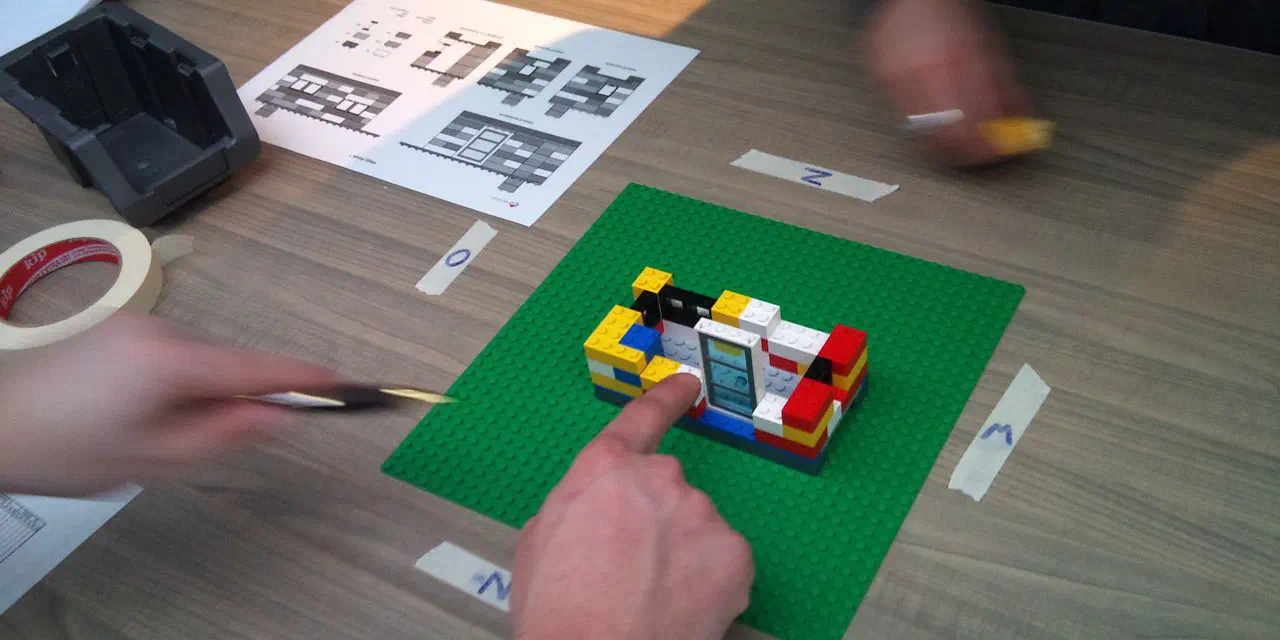
Villego® is a hands-on Last Planner System simulation in which a project team builds a small house, or villa, from small bricks in two rounds. The first uses the usual push approach; the second uses the Last Planner way. Observers record construction time, waste, safety, productivity and PPC, or Percent Plan Complete, the percentage of planned commitments completed as promised.
That comparison gives you a useful question for a takt discussion: did the next crew receive usable work, or did the previous crew merely finish its own assignment? A timetable doesn't answer that question.
Frandson, Berghede and Tommelein (2013), in Takt Time Planning for Construction of Exterior Cladding, describe a four-day takt on a healthcare facility in Sacramento, California. The first three production plans were missed; the remaining plans were achieved. Their account also describes more coordination effort than traditional exterior planning required. A beat still needs field support.
What does takt time mean in construction?
If your superintendent calls a four-day package “takt time,” an electrician might hear “four days of installation.” Those aren't necessarily the same thing. The distinction matters when you size crews.
Wikipedia's Takt time article, in its 2025 revision, defines takt through the production interval needed to meet demand. Its basic relationship is takt time = net available production time ÷ units demanded. Net time excludes planned breaks and stoppages.
In construction, the building stays put while crews move. The practical takt time construction teams use is an agreed interval for completing a defined package in one zone before moving to the next. Your milestone sets the required output; crew capacity and the work content determine whether that interval is feasible.
Cycle time measures how long the package actually takes. If a crew needs three working days within a four-day takt, don't assume the spare day is waste. It may protect the handoff against normal variation.
Takt is part of the wider family of location-based scheduling methods. Location-based plans needn't force every trade onto one common beat. So you shouldn't treat the terms as interchangeable.
How zones and wagons form a takt schedule
Say one hypothetical office wing has open workstations while the opposite wing has densely serviced exam rooms. Equal square footage won't give your mechanical crew equal workloads. A line down the middle of the floor can produce a tidy drawing and a poor production plan.
A takt zone is a physical area with a defined boundary and handoff. Start with trade quantities, installation methods and realistic crew capacity. Then adjust boundaries to balance work across zones. You don't need identical rooms, but you do need packages that fit the beat without repeated overtime.
A wagon is the work package assigned to one takt interval. It can contain one trade or coordinated parts of several trades. The ordered wagons form the trade train, the sequence that repeats through each zone. If plumbing and electrical share a wagon, their internal order and safe working space still need agreement. A shared box isn't permission to crowd crews together.
On a simple takt schedule, rows show zones and columns show equal time intervals. Colored cells identify wagons. Read across a row to see a zone's work sequence; follow one wagon diagonally to see a crew's route.
The value is visibility. You can see unfinished work piling up before it spreads across floors. That unfinished work is work-in-process, or WIP. Agree that “complete” includes the inspection and cleanup needed by the next crew, because moving early while leaving defects behind defeats the small-batch approach.
Use the same zone IDs on drawings and material deliveries. If the board says Z3 but the pallet says “second floor,” your logistics plan hasn't reached the workface. A spreadsheet or wall grid can work; software won't resolve ambiguous boundaries.
A worked takt calculation for a US building
A milestone date can make an impossible rhythm look attractive. Say a general contractor in Columbus, Ohio, is planning a hypothetical four-story medical office building. The team wants a repeatable interior drywall phase, rather than a takt plan for the entire building.
Assume each floor has two balanced zones, giving eight zones. Each zone passes through five wagons. The team proposes a four-working-day takt, with these hypothetical durations after reviewing quantities and methods:
| Wagon | Work package | Estimated working days per zone |
|---|---|---|
| 1 | Partition framing | 3 |
| 2 | Coordinated in-wall MEP rough-in | 4 |
| 3 | Testing, in-wall inspection and corrections | 2 |
| 4 | Drywall hanging | 3 |
| 5 | Drywall finishing | 4 |
MEP means mechanical, electrical and plumbing. Here, those coordinated scopes are assumed to fit the package. You'll need to test that assumption with the foremen, along with inspection availability and required drying times. You can't shorten curing or hide additional passes to make the table work.
For a single uninterrupted train, each wagon occupies one takt slot per zone. Its ideal phase duration is:
Duration = (number of zones + number of wagons − 1) × takt time
Duration = (8 + 5 − 1) × 4 = 48 working days.
The first zone needs five intervals, or 20 working days. Seven more zones each add one four-day interval, giving another 28 days. That independently checks the 48-day result. Zone 8 starts on working day 29 and finishes on day 48.
Assume a separate four-working-day end buffer. The phase allowance becomes 48 + 4 = 52 working days, or 52 ÷ 5 = 10.4 five-day workweeks, excluding holidays. That buffer is illustrative, not a standard percentage.
The formula assumes all zones are released in time, sufficient dedicated crews are available, and wagons move without interruption; it doesn't include additional gaps between wagons or compensate for crews assigned to other work. If framing and drywall hanging require the same unavailable crew, the arithmetic doesn't establish feasibility. Nor does 48 days represent the whole building's duration. Check interfaces with enclosure, other phases and commissioning in the master schedule.
How takt time planning and Last Planner share one plan
Back at the hypothetical medical office, Zone 3's rough-in is scheduled next week, but a wall detail remains unresolved. Copying its colored cell into a weekly plan would turn an assumption into an unreliable promise.
Frandson, Berghede and Tommelein (2014), in Takt-Time Planning and the Last Planner, explain how the methods complement each other. Takt provides structured batches and continuous flow where feasible; LPS provides production control and adaptation where continuous flow isn't possible.
Your team can connect them through four conversations:
- Agree the sequence and handoffs. Use pull planning from the phase milestone to establish what each successor needs. Develop zones and wagons with the people doing the work, then check whether the resulting rhythm meets the milestone.
- Make the coming zones ready. In your look-ahead schedule, screen each package for missing information, materials, access and other prerequisites. Make-ready means removing those constraints before crews arrive. Give each unresolved item an owner and a required removal date.
- Secure specific weekly commitments. A last planner, usually the foreman with authority over the crew, confirms the ready work they can deliver. A weekly work plan states the zone, scope, completion condition and handoff date. It shouldn't consist of unexplained wagon names.
- Check progress and learn. Compare actual production with the next release condition daily. Review PPC weekly and record reasons for variance, the causes of missed commitments. Change the production arrangement if repeated misses reveal a package that doesn't fit.
Don't build separate, conflicting schedules for these conversations. Keep zone IDs and completion conditions consistent. A foreman can adjust task order inside a wagon if that doesn't damage the agreed handoff. But a change crossing the next release date needs discussion with affected trades.
The honest answer to “Can you still promise Friday?” may be no. That early warning gives you time to solve the wall detail rather than move the problem downstream.
When takt is a poor fit
A renovation crew opening unknown walls can't promise equal work content in every room. A central equipment room might also need a different sequence from repetitive office zones. Forcing either into the standard train can create waiting instead of flow.
Takt is a poor fit when you can't define stable work packages, balance their workloads or secure usable locations ahead of the train. Frequent design changes, uncertain existing conditions and irregular access windows can overwhelm a fixed beat. A shared crane or specialist crew can also set the actual production limit, regardless of available floor space.
Repetition helps, but lack of identical rooms doesn't automatically rule takt out. You may be able to balance different rooms through different zone sizes. The test is whether crews can execute the resulting packages safely and repeatedly, not whether the floor plan looks uniform.
For your hypothetical office project, keep repetitive suite work in the train and plan the equipment room separately. Connect both to explicit milestones. If a phase needs a unique dependency sequence or variable production rates, don't insist on one beat; keep LPS readiness checks and commitments regardless.
Avoid shrinking zones merely to show a shorter duration. More boundaries mean more moves and inspections, and a short takt can consume its apparent savings in setup. Pilot a representative zone first. You'll learn more from an observed handoff than from a perfectly colored grid.
Protect the handoff before protecting the beat
Suppose the hypothetical inspection is missed on Wednesday. Sending the drywall crew into that zone anyway might preserve the appearance of movement, but it risks covering unapproved work. Your recovery rule needs to exist before that decision arrives.
Agree who can pause a release, how buffers may be used, and what ready alternative work is available. That alternative is a workable backlog, prepared work crews can safely do if their planned assignment is blocked. Don't raid tomorrow's zone unless its prerequisites are cleared and the affected foremen agree.
Track accepted zone handoffs alongside PPC. A high weekly score doesn't prove that the train reached its milestone if promises omitted the release conditions. And a missed small task needn't stop the train if the successor still receives everything required.
Takt sets a rhythm by area. Last Planner keeps readiness and commitments connected to field conditions. Keep the beat where it supports usable handoffs, and revise it when the evidence says your production design needs to change.
Sources
- Wikipedia (2025). Takt time.
- Adam Frandson, Klas Berghede and Iris D. Tommelein (2013). Takt Time Planning for Construction of Exterior Cladding.
- Adam Frandson, Klas Berghede and Iris D. Tommelein (2014). Takt-Time Planning and the Last Planner.