
The drywall crew is booked for Monday. The schedule shows framing complete, but nobody has confirmed the above-ceiling inspection or checked whether the latest detail changes the wall backing. You'll have people on site and work they can't finish.
A look ahead schedule should expose that problem while you still have time to act. It translates upcoming project activities into crew-sized tasks, tests their prerequisites and organizes the actions that make them ready. The output should be executable work.
Here's how to choose your planning window, screen work and connect make-ready decisions to weekly commitments.
What a look ahead schedule must do
A three-week extract can show every trade in the right order and still send crews into unfinished areas. Dates describe intent. They don't prove readiness.
Within the Last Planner® System, a lookahead schedule is the rolling plan used to turn work that should happen into work that can happen. Make-ready means identifying and removing the obstacles to performing that work. The last planners, usually foremen or other people who direct crews, supply the knowledge needed to test those obstacles.
Ballard (2000), in The Last Planner System of Production Control, describes lookahead planning through screening and pulling, matching work to capacity and maintaining a backlog of ready work. His discussion allows windows of 3 to 12 weeks, selected around project conditions and prerequisite lead times. The shorter windows discussed here are practical choices, not a universal LPS rule.
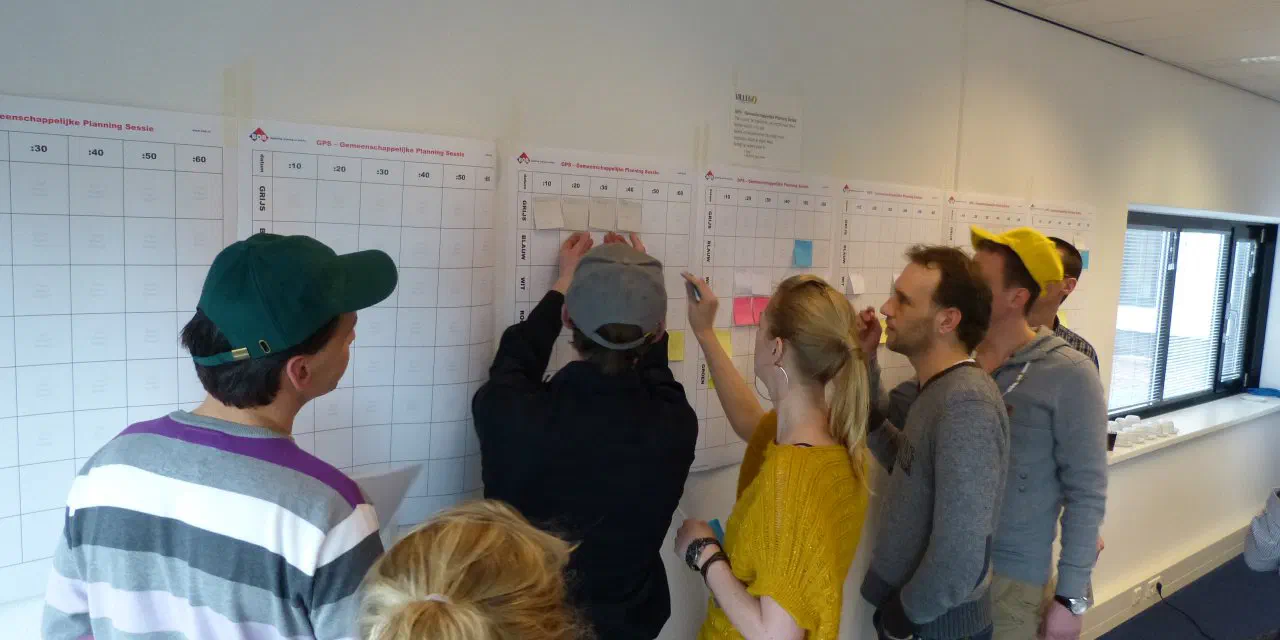
A team can rehearse the difference before applying it on site. Villego® is a hands-on Last Planner System simulation in which a project team builds a small house, or villa, from small bricks in two rounds: first the usual push way, then the Last Planner way. Observers record construction time, waste, safety, productivity and Percent Plan Complete (PPC), the share of promised tasks completed. The comparison gives the team a shared setting for discussing why work should be prepared before it's released.
On your project, keep the master schedule as the overall milestone and dependency framework. Use the lookahead to test feasibility in the field. It doesn't replace the baseline or authorize changes to contractual dates.
Should you look ahead two, three or six weeks?
Say, in a hypothetical project, a general contractor in Columbus, Ohio, is building a four-story medical office building with 14 trade partners. A two-week view reveals a needed inspection, but the required access equipment takes four weeks to arrange. Discovery came too late.
Common lookahead windows cover 3 to 6 weeks. But you shouldn't choose the length because a familiar spreadsheet has that many columns. Your window must give you time to clear the constraints that regularly affect the phase, with enough room for a missed response or a changed sequence.
When a two week look ahead works
A two week look ahead can suit repetitive finish work where materials are available, details are settled and supporting work is already ready. You can plan at close range without spending hours revising distant task dates. It's a poor sole planning window if approvals or deliveries routinely take longer than two weeks.
You can retain the two-week display for field coordination while tracking earlier preparation in a longer make-ready process. Don't mistake a narrow display for the entire planning horizon.
Why choose a 3 week look ahead?
A 3 week look ahead gives the team a near-term execution week and room to prepare the following work. For the hypothetical Columbus project, that might cover inspection, wall closure and the next room handoff. It works if the remaining constraints can realistically be removed within that period.
The third week won't be as certain as the first. That's acceptable. Its purpose includes finding questions early, rather than collecting premature crew promises.
When six weeks is more useful
A six-week window gives you earlier notice of coordinated fabrication, shared equipment or approval needs. The far edge needs less detail. Broader work packages can show preparation needs there; add operational detail as execution approaches. You don't need daily assignments for every distant activity.
Long-lead procurement still belongs in the master or phase plan. A six-week view can't manage an item that must be released months earlier. Keep ordering milestones visible in those longer-range plans, with a named owner who follows up before installation enters the lookahead.
Pull tasks from the handoff, then size the work
On the hypothetical medical office project, “complete second-floor interiors” tells the drywall foreman very little. Which rooms? Which walls can close? What does the following trade actually need?
Start with the phase sequence and the next required handoff, meaning the condition one crew must deliver so another can proceed. In pull planning, trades negotiate those handoffs backward from a milestone. The lookahead carries that sequence into near-term preparation; it shouldn't become a separate plan built from whichever work is easiest to start.
Hamzeh, Ballard and Tommelein (2008), in Improving Construction Work Flow – The Connective Role of Lookahead Planning, describe lookahead planning as the connection between long-term planning and commitment planning. Their process breaks activities into finer detail as they approach execution and creates a workable backlog, a supply of constraint-free work available for selection.
For your next phase, split a broad activity by location and a measurable output. “Hang corridor-side board in rooms 201–206 after in-wall inspection acceptance” can be screened. “Drywall Level 2” hides too much.
Keep the task reference tied to its parent schedule activity. You'll need that connection if a blocked task threatens the milestone. Include work already underway that will finish inside the window, since its incomplete handoff can block a successor just as easily as a late start.
Screen constraints and pull the prerequisites into place
An electrical foreman says the material is “ordered.” That doesn't tell the next trade whether the right parts will reach the correct floor before installation. A vague assurance isn't clearance evidence.
Screening means examining each task for missing prerequisites and preventing unready work from advancing into execution. Pulling means requesting and securing those prerequisites in response to the task's actual need. Extraction alone won't clear those constraints. Copying activities from a master schedule doesn't secure the inputs crews need.
Hamzeh, Ballard and Tommelein (2012), in Rethinking Lookahead Planning to Optimize Construction Workflow, describe both processes and give a framework for activity breakdown, constraint removal and operation design. They identify sluggish constraint removal and inadequate lookahead practice among the implementation problems they examined.
A useful screening conversation follows this sequence:
- Define the result. Agree on location, quantity and acceptance conditions. If the foremen interpret “ready for ceilings” differently, you haven't defined a usable handoff.
- Test prerequisites. Check current design information, approved materials, predecessor acceptance, available crews, equipment, safe access and relevant permits or inspections. Check weather exposure where it affects the method.
- Assign removal actions. Name the person who can obtain the missing item, record the action and set a clearance date before the dependent work needs it.
- Verify closure and recheck sequence. A delivery ticket, accepted inspection or field walk can support closure. A promise to resolve the issue can't establish that it's resolved.
Separate “ready now” from “can be made ready by the need date.” Future tasks may remain in preparation with a credible removal plan. Only cleared, correctly sequenced tasks enter the workable backlog. If you can't establish a credible path to readiness, flag the task as blocked and assess the consequence; don't hide it by deleting the row.
Use constraint analysis to maintain the linked removal actions. The schedule shows the affected work and its timing; the constraint log records who must clear each obstacle, by when and with what evidence. You'll avoid conflicting status reports if both use the same task and constraint references.
A hypothetical 3 week look ahead schedule
In the hypothetical Columbus project, wall closure in the east corridor depends on accepted in-wall work. Before Week 1, the team reviews this hypothetical 3 week look ahead schedule and asks which tasks can proceed, which need preparation, and which should stay blocked until a predecessor clears. All tasks, durations and readiness judgments below are illustrative, not results from an actual project.
Week labels represent successive working weeks. Dates for constraint clearance would be entered as actual calendar dates on the live project.
| Task and trade | Week 1 | Week 2 | Week 3 | Readiness at review | Make-ready action and owner |
|---|---|---|---|---|---|
| A: Frame east corridor, framing crew | Complete, 2 days | — | — | Ready; layout accepted, material and access confirmed | Foreman confirms completed handoff |
| B: Install in-wall electrical, electrical crew | Install, 2 days after A | — | — | Conditional on A's accepted handoff | Electrical foreman walks area after A |
| C: Inspect corridor in-wall work, coordinated by GC | — | Inspect, 1 day after B | — | Inspection slot unconfirmed | Superintendent secures slot by end of Week 1 |
| D: Close corridor walls, drywall crew | — | Install, 2 days after C acceptance | — | Blocked by C; board delivery unverified | Drywall foreman verifies delivery by end of Week 1 |
| E: Finish corridor board, finishing crew | — | — | Finish, 3 days after D | Conditional on D and suitable conditions | Finishing foreman confirms dry area before commitment |
| F: Install backing in west rooms, carpentry crew | Available, 1 day | Available if still needed | — | Ready; independent of corridor inspection | Superintendent holds as approved fallback |
Task C isn't “ready” because someone intends to call the inspector. Task D must wait for clearance. If C slips, moving D's bar without revisiting E's handoff leaves the risk unresolved.
The example also separates early preparation from release. The drywall foreman can confirm board delivery now, while inspection remains open. The inspection still blocks wall closure. Confirming delivery removes one constraint without pretending the whole task is executable. Task F provides an alternative only if its crew, access and priority still fit.
Build a workable backlog without creating busywork
The corridor inspection slips in the hypothetical example. The carpenter could take Task F, but sending the drywall crew there without the right capability would create another false start. A ready task is useful only to a crew that can perform it.
Group your workable backlog by trade and location, then rank tasks against the phase handoffs they support. Include accepted prerequisites, expected effort and any limit on when the task may be released. Some work is ready physically but would obstruct access if started early. It shouldn't be treated as an unrestricted fallback.
Capacity matters too. In a separate hypothetical check, a four-person crew working eight hours daily over five days has 4 × 8 × 5 = 160 gross labor-hours. Two proposed assignments estimated at 72 and 64 labor-hours require 72 + 64 = 136 hours, leaving 160 − 136 = 24 hours before other demands.
That isn't proof the plan fits. The estimate may assume uninterrupted access, while unloading and shared-lift waits reduce available working time. Compare task demand with usable capacity, using current field conditions and the crew's input. Don't fill every apparent hour just because a task is ready.
For an unfamiliar operation, a first-run study, a planned trial of the method, can reveal access or production problems before the crew repeats them across the floor. Record what changed and adjust the task size. Readiness includes knowing how you'll do the work, not merely possessing the inputs.
Feed the weekly work plan with evidence, not forecasts
A foreman sees Task D under Week 2 and assumes the crew has already promised it. But the inspection hasn't cleared. A lookahead forecast can be mistaken for a commitment if the team uses one board without clear status labels.
Use the lookahead to prepare options for the weekly work plan. At the commitment meeting, last planners select work from the ready backlog, confirm capacity and agree on what they'll finish during the coming week. They'll also check whether a task's readiness has changed since the last review.
Where a successor depends on work committed within that week, describe the handoff explicitly. In the example, B depends on A's completion and acceptance. The team must validate that sequence and its capacity; an unresolved external approval is a different risk and shouldn't be treated as an equivalent promise.
Keep fallbacks separate from committed assignments. If a crew finishes early, it can request release of a suitable backlog task without inventing work. Unplanned extra production shouldn't quietly replace a missed commitment in your reliability record.
Roll the window forward and keep one usable version
On Thursday, a project engineer has last week's export while a foreman has a newer board photo. Each thinks a different person owns the board delivery. Better formatting won't fix that ownership gap.
A spreadsheet is sufficient if the team can keep it current. A Gantt export preserves schedule references; add readiness fields so the field team can distinguish a target date from clearance to start. A shared board can support conversation, provided someone records the agreed changes. Choose the format your trade partners can read and update; software isn't a substitute for screening.
Your template needs a task reference, location and output, responsible trade, planned timing and duration, predecessor handoff, readiness status and linked constraint actions. Show the revision date. Distinguish the task performer from the constraint owner, since a foreman may depend on a project engineer to obtain an answer.
The superintendent can coordinate a weekly review with trade foremen and the people responsible for clearing constraints. Project engineers bring approval and procurement evidence; trade leads bring actual crew capacity and workface conditions. You'll get better decisions when each person arrives with verified updates.
Roll the window forward weekly, retaining unfinished work and adding the newly visible period. Recheck current prerequisites and pull overdue actions into the discussion. Between meetings, communicate changes that affect release immediately. If readiness failures threaten a phase milestone, review the higher-level schedule and recovery options rather than repeatedly sliding the lookahead dates.
Check readiness before a high PPC reassures you
A crew can keep its weekly promises while completing low-priority tasks. That won't tell you whether upcoming corridor handoffs are being prepared. Reliability and project progress answer different questions.
Percent Plan Complete helps you learn whether weekly commitments were kept. It doesn't directly measure physical progress or show whether future constraints are clearing. Hamzeh, Ballard and Tommelein (2012) discuss Tasks Anticipated and Tasks Made Ready as lookahead measures alongside PPC.
For your review, preserve earlier plan versions and ask which promised tasks were visible in advance, which planned tasks became executable, and why others didn't. Use consistent task definitions when comparing weeks. Splitting one task into several new rows can otherwise make the comparison misleading.
Record reasons for variance. These are the causes of differences between planned and completed work. If inspection requests repeatedly come late, change the request timing or ownership. A better color code won't remove that cause.
Ready work must reach the next handoff
A blocked corridor and a full backlog of unrelated work can coexist. Your team may look busy while the phase milestone gets further away.
The next review should identify the handoff you need, the tasks that support it and the remaining obstacle to each task's release. Then check that someone has both responsibility and enough time to clear that obstacle. If they don't, escalate the decision while there's still room to respond.
That's the standard worth applying to a lookahead schedule: it produces ready work in the sequence the project needs. The bars remain useful, but the readiness decisions determine whether crews can keep moving.
Sources
- Herman Glenn Ballard (2000). The Last Planner System of Production Control.
- Farook R. Hamzeh, Glenn Ballard and Iris D. Tommelein (2008). Improving Construction Work Flow – The Connective Role of Lookahead Planning.
- Farook Hamzeh, Glenn Ballard and Iris D. Tommelein (2012). Rethinking Lookahead Planning to Optimize Construction Workflow.