
Your schedule says the drywall crew starts Monday. The framing looks finished, but an above-ceiling inspection hasn't happened and the electrical foreman still needs access. You can put people in the area. You can't give them a dependable work assignment.
The Last Planner® System (LPS) connects project planning with the decisions that release work to crews. If you're evaluating the last planner system, start with those decisions: what should happen, what can happen, what people will commit to, what actually happened and what the team learned. This guide explains how the conversations fit together, where reliability comes from and why implementations fail.
What is the Last Planner System?
A wall of sticky notes can show a sensible sequence while crews still wait for information. The missing piece is the continuing conversation about readiness and commitments. LPS is a collaborative production planning and control system that helps teams prepare work, make dependable promises and improve the way work moves between them.
Mossman (2015) describes five connected conversations, plus first-run studies. Mossman (2020) calls them phase planning, lookahead planning, commitment planning, production management and measurement with learning. Master or milestone planning gives these conversations their overall direction.
The records matter. But a completed form doesn't establish that two foremen mean the same thing by “ready.” That's why practicing the conversations can be more useful than starting with templates.
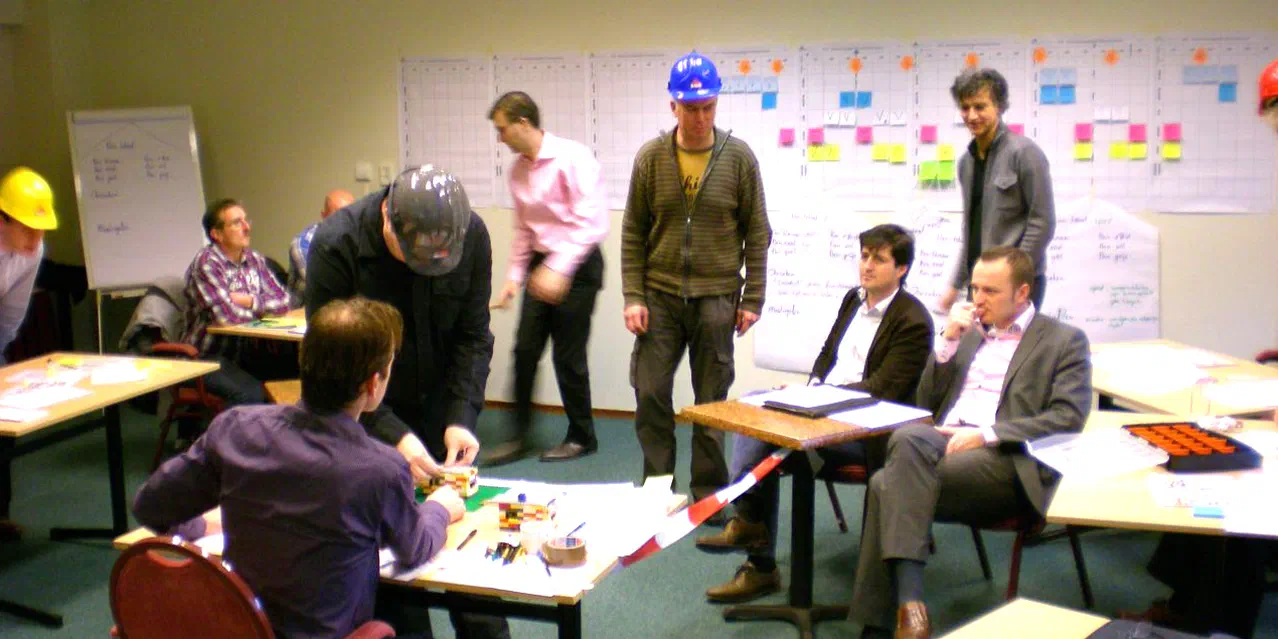
Villego® is a hands-on Last Planner System simulation in which a project team builds a small house, or “villa,” from small bricks in two rounds: first the usual push way, then the Last Planner way. Observers record construction time, waste, safety, productivity and PPC, the proportion of planned commitments completed. Participants can discuss the differences together. They have a shared experience to connect planning behavior with production.
On your project, a useful test is whether each conversation changes what happens next:
| Planning conversation | Question the team answers | Decision it supports |
|---|---|---|
| Master and milestone planning | What outcomes are required, and when? | Phase boundaries and major commitments |
| Phase or pull planning | What should happen to deliver this milestone? | Agreed sequence and handoffs |
| Lookahead and make-ready | What can happen after we remove constraints? | Release of ready work |
| Weekly work planning | What will each team complete? | Specific crew commitments |
| Daily check-ins | What happened, and what needs attention today? | Coordination and recovery |
| Learning | Why did performance differ from the promises? | Changes to planning and production |
Who is the last planner, and why does their promise matter?
Say a general contractor in Columbus, Ohio, is building a four-story medical office with 14 trade partners. The project manager requests completion of corridor rough-in. The electrical foreman knows which crew is available, which circuits need clarification and whether the shared lift is free. Those aren't details a distant scheduler can safely assume.
In his University of Birmingham PhD thesis, Ballard (2000) defines the last planner as the person or group producing assignments that directly drive work, rather than another plan. In construction, that's commonly a trade foreman or field supervisor. In design, it may be a discipline lead.
Proximity alone isn't enough. Your last planner needs authority to commit resources and a way to check the proposal with the crew. They also need permission to decline an unsound request. A forced “yes” won't make missing material arrive.
Ballard and Howell (1998) explain shielding production through quality assignments that meet soundness, sequence and size criteria. The team protects crews from foreseeable upstream uncertainty by selecting work that's ready and achievable.
That changes the basis of the promise. It combines local knowledge with checked prerequisites and negotiated dependencies, rather than relying on optimism or pressure. You still need supervision. You also need management to remove obstacles the foreman can't control.
Where did LPS come from?
If your team assumes LPS is a manufacturing checklist imported unchanged onto a jobsite, the purpose can get lost. A concrete placement depends on temporary teams and changing field conditions; it needs a production control approach suited to those conditions.
Mossman (2020) traces Ballard and Howell's work to construction productivity research in the 1980s. Ballard (2000) dates development of the named system to 1992 and records their founding of the Lean Construction Institute in August 1997. His thesis examines work planning reliability through case studies in construction and design.
Koskela (1992), in Application of the New Production Philosophy to Construction, challenged the traditional production view. His work helped establish the lean construction argument for considering flow and waste, alongside the activities that transform inputs into outputs.
The practical lesson is to improve the whole production process. Making one crew busier won't help if its output blocks the next trade. Lean project delivery goes beyond LPS.
Master and milestone planning: agree what finished means
Back on the hypothetical Columbus project, “ready for commissioning” appears on the master schedule. The controls contractor understands that as installed equipment; the owner expects completed testing prerequisites. The date looks clear. The outcome isn't.
Master planning sets the overall project strategy and major milestones. Your owner, project management and relevant design and construction representatives need a shared definition of each outcome, including the conditions of satisfaction: the checks that establish acceptable completion.
For commissioning readiness, those checks might include permanent power, approved test procedures and the required inspections. The exact list depends on your scope. Defining it early gives the phase planners something concrete to work backward from.
A critical path method schedule, or CPM schedule, can still serve contractual reporting and analysis of project dependencies. LPS adds the collaborative production control needed to make the near-term work executable. You don't need to throw away the master schedule; you need to connect it to field decisions and update the forecast when evidence changes.
Phase planning: negotiate the handoffs backward
Say the hypothetical milestone is release of a floor for finishes. A forward schedule might list framing, rough-in, inspection and drywall without revealing what each trade needs from its predecessor. Then “finished” becomes an argument in the corridor.
Phase planning brings the people responsible for that work together. Through pull planning, they work backward from the milestone, asking what must be delivered immediately before each task can proceed. A handoff is the transfer of an agreed, usable work area or output to the next team.
The drywall foreman might need accepted rough-in, a clear work area and confirmation that remaining access above the ceiling won't damage completed work. That request shapes the earlier trades' promises. It also exposes inspections and decisions that otherwise disappear between schedule bars.
Each proposed activity needs a location, duration and responsible performer. Your team can then check the sequence forward, compare resource demands and discuss risk buffers openly. Durations should reflect achievable work under the stated conditions, not hidden allowances for missing prerequisites.
Pull planning isn't the whole LPS. It establishes what should happen. The following conversations determine whether that sequence can happen and what the team will actually promise. A good workshop followed by neglected make-ready work produces an attractive plan with unreliable execution.
Lookahead and make-ready: create work crews can execute
Suppose a ceiling closure task enters the Columbus project's six-week planning window. The drawings are available, but a fire alarm detail is unresolved and the inspection booking hasn't been confirmed. Copying the task into a shorter schedule won't remove either obstacle.
The look-ahead schedule is the team's view of approaching work. Make-ready is the process of identifying and removing constraints, anything that could prevent the work from starting or finishing as intended. The output should be ready work.
Mossman (2020) describes lookahead periods commonly ranging from four to eight weeks. Your horizon should allow time for the constraints you can realistically address. Long-lead equipment needs earlier attention. Design decisions may need it too. Those belong in the milestone or phase plan; they can't wait until they enter a short lookahead.
Your screening needs to consider completed prerequisite work, approved information, material availability, capable labor, tools and equipment, safe working space and external conditions. Shared understanding belongs in that check too. “The drawings are issued” doesn't establish that the crew and receiving trade understand the same completion standard.
For the unresolved fire alarm detail, effective constraint analysis records the affected task, a named action owner, a required removal date and evidence that the issue is cleared. “Design team to resolve” is too vague. A named project engineer can secure the needed response and check that it reaches the foreman.
Management owns its share of make-ready. The GC may need to coordinate inspection access; procurement may need to confirm delivery. Foremen shouldn't be made accountable for decisions outside their authority without a working escalation route.
And readiness has to be checked again. If the detail changes after clearance, the task may no longer be sound. A green mark from last week isn't permanent permission to proceed.
Weekly work planning: promise achievable, useful work
Say an electrical foreman proposes “continue second-floor rough-in.” You can't reliably tell whether that promise was kept, and the next trade can't use it to plan a start. The assignment needs a finish line.
A weekly work plan records commitments for the next production period. The last planners bring proposals, check dependencies together and agree what their crews will complete. Each promise needs a responsible performer. It specifies the work, location, completion condition and due day.
Ballard (2000) identifies assignment quality through definition, soundness, sequence and size, with learning from noncompletion. For the foreman, that means checking the scope is clear, prerequisites are ready, the order helps the receiving trade and the crew has sufficient capacity.
Here's a hypothetical capacity check. Four workers available for 40 hours each provide 4 × 40 = 160 worker-hours. If the proposed work requires 136 worker-hours, the arithmetic leaves 160 − 136 = 24 worker-hours. That isn't automatically spare installation time: access restrictions, coordination and other duties may consume it. You don't have to fill every nominal hour with commitments.
Your team can identify a workable backlog, ready alternative work available if the main assignment is blocked or finishes early. It shouldn't disrupt another trade's sequence. Separating those alternatives from firm commitments keeps the plan honest while giving the crew a useful response to changed conditions.
Daily check-ins: protect the promises before they fail
On Wednesday morning, suppose the plumbing foreman says a delivery will arrive after lunch instead of before the shift. If the team waits until Friday to discuss the missed handoff, the follow-on crew loses the chance to adjust.
A daily huddle is a brief production management conversation. It connects yesterday's actual completions with today's work and the promises now at risk. Mossman (2020) describes these meetings as generally no longer than 15 minutes.
Your foremen need to identify what's ready to transfer, what has changed and who needs help. The superintendent can coordinate a response; detailed problem-solving can continue afterward with the affected people. A huddle shouldn't become a recital of every activity onsite.
When a commitment must change, the receiving trade needs an explicit notification and a credible revised handoff. You can't preserve the original promise by silently moving its date. The original outcome still belongs in the learning record, even when the recovery decision is sensible.
PPC and reasons for variance: learn without gaming the score
Suppose the hypothetical team promises 24 assignments and completes 18 to their agreed conditions by their due dates. Someone proposes crediting almost-finished tasks to make the report look better. That would hide the handoffs that weren't delivered.
Percent Plan Complete, or PPC, measures commitment reliability: completed planned assignments divided by total planned assignments, multiplied by 100. Here, PPC = 18 ÷ 24 × 100 = 75%. Each assignment is complete or incomplete against its agreed definition. Partly finished work may have earned value, but it hasn't fulfilled the whole promise.
PPC doesn't measure the percentage of the project built, labor productivity or the amount of critical work accomplished. A week of easy assignments can yield a high score while an important milestone slips. So you'll want milestone forecasts and production measures alongside PPC.
Reasons for variance explain why actual delivery differed from the plan. “Materials late” is a starting category, not an explanation you can act on. An unplaced order needs a different countermeasure from a delivery rejected because there's nowhere safe to unload.
Your team can examine a specific missed promise, trace what happened and agree a change with an owner. Next week's review should check whether that change worked. Useful learning also asks why required work never became ready enough to enter the weekly plan.
Mossman (2015, 2020) warns that PPC is easy to manipulate when used for purposes other than learning. Punishing low scores encourages smaller promises and concealed failures. Honest reporting matters more than a perfect graph. Early finishes deserve discussion too, especially when downstream teams weren't ready to use the released work.
First-run studies: learn before repeating a poor method
Say the Columbus team plans repeated overhead equipment installations in tight rooms. Every task could be constraint-free while the installation method still creates awkward handling and repeated repositioning. Ready work can still contain waste.
Mossman (2015, 2020) includes first-run studies as the additional conversation that can occur at different points in LPS. These are planned trials or rehearsals of an operation, followed by observation and improvement. They can address unfamiliar or hazardous work as well as repeated tasks.
Your installers, supervisors and others affecting the operation can agree the method, test it under controlled conditions and compare the result with expectations. The revised method then informs durations, equipment needs and readiness checks. This connects learning about how to perform work with learning about how to plan it.
What benefits does the evidence support?
If your sponsor asks for a guaranteed productivity gain, a universal percentage won't provide a sound business case. A small commercial fit-out and an industrial mining project have different risks. The evidence supports testing improvement, with clear comparison measures.
Ballard (2000) investigated increasing planning reliability beyond 70% PPC through three construction case studies; the final case achieved the 90% target. That demonstrates achievable reliability in a studied implementation, rather than an industry-wide expected result.
Leal and Alarcón (2010) analyzed three LPS industrial mining projects within one company. Their labor efficiency indices, used labor divided by earned labor, were 0.96, 1.12 and 1.02, compared with 1.42 and 1.65 on two parallel projects without LPS. Lower values indicate less labor used per unit of earned labor.
All three LPS cases recorded zero accidents. However, the detailed paper reports an average schedule deviation of 7.9%, mainly attributed to external causes or client requests and accepted without penalties. Its abstract's statement that projects finished on schedule shouldn't be read as zero deviation from original contractual durations. The cases were observational, so differences in project conditions and other management practices mean we can't isolate LPS as the sole cause of improvement.
Warcup and Reeve (2014) studied Villego with 31 participants across student and professional groups. Student simulation construction time changed from 11:31 to 5:33. Professional team 2's waste penalties rose from 16 to 172. Those results support discussing learning and trade-offs; they aren't forecasts of live-project savings.
For your pilot, reduced waiting and fewer failed handoffs are plausible mechanisms for better productivity and cost performance. You'll need actual production, cost and safety records to establish whether those benefits occurred.
Common implementation failures you can recognize
A project can hold every meeting and still push unready work into production. Say the GC completes the weekly board before the foremen arrive, then asks them to agree. Attendance hasn't created collaborative planning.
The facilitator makes everyone's promises. The last planners need to propose and negotiate their own work. Otherwise, you lose their knowledge and ownership. Your facilitator's job is to expose conflicts and help the team reach workable agreements.
Constraints remain on a list without action. Owners need removal dates and follow-up. An unresolved inspection request won't improve because the log looks orderly. Leadership needs to respond when the team raises a blocker.
Pull planning becomes a one-time event. The phase plan needs make-ready, weekly commitments and daily coordination. Without those connections, you've documented intent but haven't controlled production.
PPC becomes a trade ranking. Interdependent crews don't operate in isolation. Looking at the circumstances of missed promises is more useful than treating a low score as proof of poor effort.
Technology replaces participation. Software can make changes visible and reduce duplicate entry. It can't negotiate a handoff or decide whether a foreman can keep a promise. A simple board that crews understand is preferable to a digital plan they don't use.
For a Last Planner System construction rollout, these failures are reasons to coach behavior and improve management responses, rather than distribute more forms.
Reliable production needs the whole conversation chain
If the hypothetical Columbus pilot improves weekly PPC but still misses finish-release dates, the team shouldn't declare success yet. It needs to check whether the promises advance the phase plan and whether required work is becoming ready soon enough.
One willing project team can start. It needs leadership support and a coach who understands the full system. Before the next phase, you can agree milestone conditions, negotiate handoffs and establish constraint-removal responsibilities. Weekly commitments, daily check-ins and a regular learning review then test the plan against reality.
You can also begin on an active project. Mossman (2020) describes starting with commitment planning and learning, then building the other conversations as the causes of unreliability become clear. Incremental adoption shouldn't become permanent omission.
Using the Last Planner System in construction means keeping those connections working. The decisive question is whether your next crew can trust the handoff you've promised, and whether your team changes the conditions that made the previous promise fail.
Sources
- Alan Mossman (2015). Last Planner®: 5 + 1 crucial & collaborative conversations for predictable design & construction delivery.
- Alan Mossman (2020). Last Planner: 5 + 1 crucial & collaborative conversations for predictable project production planning.
- Herman Glenn Ballard (2000). The last planner system of production control.
- Glenn Ballard and Gregory Howell (1998). Shielding Production: Essential Step in Production Control.
- Lauri Koskela (1992). Application of the New Production Philosophy to Construction.
- Mauricio Leal and Luis F. Alarcón (2010). Quantifying Impacts of Last Planner™ Implementation in Industrial Mining Projects.
- Robert Warcup and Edward Reeve (2014). Using the Villego® Simulation to Teach the Last Planner® System.