
A pull planning session can fill a wall with sticky notes while leaving the hardest questions unanswered. Who releases the corridor for inspection? Does the drywall foreman agree? Dates will come up repeatedly. They don't tell crews what they'll receive from one another.
You're there to facilitate, not dictate. This guide covers invitations, preparation, room setup and a two-and-a-half-hour agenda within the Last Planner® System (LPS). For the method itself, use the pull planning guide. Here, we're concentrating on what you do before, during and after the meeting.
Rehearse the conversation before the project meeting
A foreman who hasn't planned backward may freeze when asked what must happen before an inspection. Explaining the sticky-note colors won't fix that. The team needs practice asking another trade for a specific release condition.
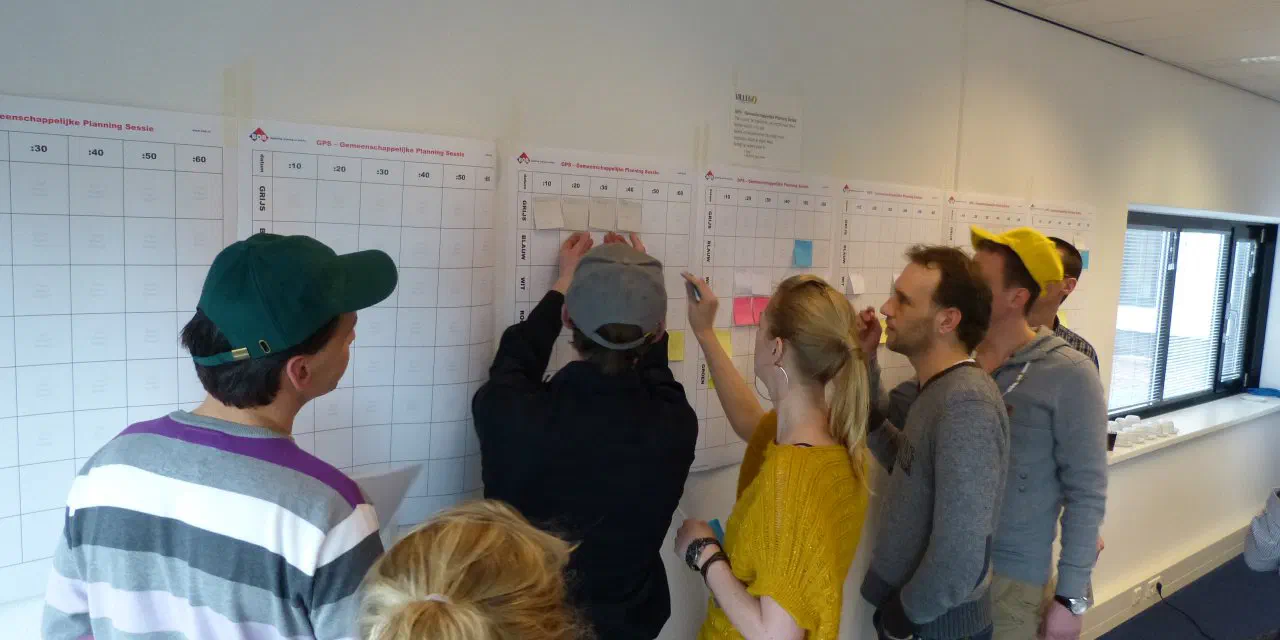
Villego® is a Last Planner System simulation in which a project team builds a small house, or “villa,” from small bricks in two rounds: first the usual push way, then the Last Planner way. Observers record construction time, waste, safety, productivity and PPC. PPC means Percent Plan Complete, the share of promised tasks completed as agreed.
Rehearse these conversations before the real session. A simulation like this gives your team a shared reference for discussing handoffs. Schedule it separately; don't squeeze a full simulation into the agenda below.
Warcup and Reeve (2014) reported that 19 of 25 respondents, or 76%, identified communication, collaboration, teamwork and commitment as their main lessons after the simulation. They also described teams getting stuck while planning backward. Coaching two planners to agree their handoff helped. This was a small qualitative study. It doesn't establish project performance gains, and participants still needed help implementing LPS.
Invite the last planners who will release the work
Say a general contractor in Columbus, Ohio, is preparing an interior phase on a four-story medical office building, with overhead work crossing several corridors. If the electrical project manager attends without the foreman, a proposed crew size may sound reasonable while ignoring another floor's demands.
You need the last planners themselves: people who direct crews and can discuss how their work will actually be delivered. Project managers can support decisions about resources or procurement, but they shouldn't replace that field knowledge.
Your pull planning meeting needs a defined target. Identify the phase boundaries, milestone date and the condition that defines completion. Include the room, start and finish times, expected preparation and each person's role. A useful request is: “Please attend with the foreman responsible for corridor rough-in, bringing proposed activities and known blockers.”
Include the superintendent and scheduler. Invite design, procurement, inspection or owner representatives where their decisions affect this phase. A recorder frees you to facilitate.
If a required trade can't attend, arrange a qualified delegate with decision authority. Otherwise, label its inputs provisional and assign a confirmation deadline. Silence isn't agreement. An absent trade's dates aren't promises.
Send pre-work that exposes assumptions
In that hypothetical Columbus project, “ready for ceilings” could mean installed piping to one person and tested, inspected piping to another. Starting the meeting with that ambiguity wastes everyone's attention.
Send a short phase packet several working days ahead. Include current drawings, named work areas, the milestone's acceptance conditions and relevant master-schedule dates. Show work already completed and decisions still open. Ask each trade for activities by location, production durations, proposed crew sizes and prerequisites, plus known material or access restrictions.
Keep the request manageable. You don't need every installation step. An activity should end in a release another crew can recognize, such as “Level 2 east corridor overhead rough-in accepted,” rather than “continue mechanical.”
Alan Mossman (2015) describes planning backward as a way to put the next trade's needs into the preceding trade's plan. He also recommends stating task duration assuming the necessary conditions and workers are available, with buffer handled transparently rather than hidden in each duration.
So ask for the production estimate and its assumptions separately. Don't let an unsupported duration become a fact through repetition. Your scheduler should flag conflicts with contractual milestones before the room assembles, without pre-filling a sequence that everyone is expected to approve.
Give people space to reach the wall
A crowded trailer changes who participates. If the plumbing foreman can't reach the board, someone else may write his activities while he's still explaining the access problem.
The Villego kit page specifies at least 3 m / 10 ft of clear wall for its planning forms and at least 4 m² per person. Use those simulation requirements as a room-planning reference, not a universal rule for construction meetings. For a hypothetical group of 14 people, the reference area is 14 × 4 m² = 56 m². Count the facilitator and recorder too.
Check the actual wall before booking. Doors, cabinets and projectors consume usable space. Keep circulation clear. Seating should remain available for anyone who needs it; standing isn't a participation strategy.
You'll need large planning paper or a reusable board, trade-colored sticky notes, dark markers, tape, a visible timer and current drawings. Add a trade-color legend, constraint sheets, a separate space for off-scope questions and a camera or shared digital record. Materials should support the conversation.
Test a sample card from the back of the room. If the trade name, activity, location and duration aren't readable, change the format now. Digital boards need equal access too. Every planner should be able to see and edit their contribution.
A 150-minute pull planning session agenda
A discussion about one unapproved detail can consume the time intended for the whole sequence. For the Columbus example, keep this session to a defined interior phase ending at its inspection milestone, rather than trying to plan the entire building.
This is a suggested agenda, not a prescribed LPS duration. Its blocks total 10 + 15 + 15 + 35 + 10 + 30 + 20 + 15 = 150 minutes.
| Elapsed minutes | Facilitator's focus | Visible result |
|---|---|---|
| 0–10 | Confirm scope, completion conditions, roles and ground rules. | One agreed target and clear boundaries. |
| 10–25 | Each trade shares proposed activities and assumptions. | Missing participants or information flagged. |
| 25–40 | Start at the milestone; ask the receiving trade what releases it. | First explicit handoff and predecessor. |
| 40–75 | Work backward through the phase, asking trades to place their own cards. | A connected sequence with durations. |
| 75–85 | Take a break; recorder checks legibility and missing owners. | A readable working record. |
| 85–115 | Read forward; test crews, work areas, inspections and shared equipment. | Conflicts exposed and sequence revised. |
| 115–135 | Review constraints, assign action owners and needed-by dates. | A constraint list with accountable people. |
| 135–150 | Confirm handoffs, milestone feasibility, unresolved items and next review. | Agreed outputs and follow-up responsibilities. |
For a two-hour slot, narrow the scope beforehand. Reduce activity reporting and backward sequencing by 15 minutes each, but protect the final review. For three hours, add 30 minutes to test alternatives and revisit disputed handoffs. Those adjustments produce 120- and 180-minute sessions.
If the team can't support the required date, record the gap. Compressed cards won't resolve the gap. Assign someone to develop a feasible recovery option or escalate the milestone conflict.
Ground rules that keep the loudest trade from writing the plan
Say the mechanical foreman dominates the hypothetical corridor discussion while the fire protection foreman stops contributing. You might finish quickly, but you've lost information about competing overhead work.
Agree the rules before that happens: one conversation at a time; each trade speaks for its own production; receiving trades define acceptable handoffs; assumptions stay visible. People must be able to say “I don't know” or decline an unsupported date without being blamed. Phones can wait unless someone needs project information.
Use a short round-robin when contributions become uneven. Ask each affected planner what they need before asking for solutions. You'll hear more than you will from a general “Any objections?”
Interrupt behavior without attacking the person. You could say, “We've heard your crew requirement. Let's hear the fire protection release condition before we place this card.” Then invite the quieter trade to the wall. If someone moves another trade's card, ask its owner and receiver to confirm the change.
Don't reward volume with extra authority. But don't mistake confidence for bad information either. Ask both trades to explain quantities, crew availability and working-space assumptions. A quieter voice can be wrong too.
Separate a sequencing dispute from a missing fact. Capture the missing fact, name its resolver and set a deadline. Keep the affected dates provisional. Moving on is reasonable only when everyone can see what remains unresolved.
Make each handoff testable before accepting its date
“Mechanical complete” leaves the next trade guessing. In the hypothetical corridor, installation may be finished while testing or inspection remains outstanding. The wall needs a release condition, not a progress label.
Ask the receiver what they must find when they arrive: which location, which completed work, which acceptance evidence and what access. Ask the predecessor to confirm that condition and its duration assumptions. That's the handoff, the agreed transfer of work or space between crews.
Read the plan forward after pulling backward. Check that crews aren't assigned to incompatible areas and that simultaneous work won't create unsafe congestion. Ask about inspection availability, material delivery and shared lifts. More overlap doesn't automatically mean faster production.
Write unresolved prerequisites into the constraint list. Make-ready means removing those blockers so the planned work can actually start. Keep constraint-removal actions separate from construction activities; approving a submittal isn't the same task as installing the approved equipment.
Leave with owned handoffs, not just a wall photograph
A photo labeled “final plan” won't help the Columbus superintendent if nobody knows who must arrange the inspection. Protect time for a read-back. Your minimum output is an agreed milestone plan with the phase sequence, durations and completion conditions. Add a handoff list showing predecessor, receiver, location, release condition and expected date. Keep a constraint list naming each blocker, a responsible person, needed-by date and closure evidence. “GC” isn't a sufficient owner when several people could assume someone else is handling it.
Name the person who will publish the record and reconcile it with the master schedule. Set the distribution deadline and next review before people leave. Record provisional inputs and disagreements alongside the plan, rather than burying them in private notes.
The session's phase plan describes intended work. It doesn't automatically make every task ready or turn future dates into weekly promises. Screen upcoming work through the look-ahead schedule. Build the weekly work plan from ready assignments. Daily coordination protects those assignments as conditions change; PPC and reasons for missed promises support learning afterward.
A useful closing question is specific: “Who receives this handoff, and what still prevents us from delivering it?” If the room can't answer, that part of the plan still needs work.
Sources
- Robert Warcup and Edward Reeve (2014). Using the Villego® Simulation to Teach the Last Planner® System.
- Alan Mossman (2015). Last Planner®: 5 + 1 crucial & collaborative conversations for predictable design & construction delivery.
- Villego (n.d.). Villego® kit.