
You've seen this happen. A contractor books a lean workshop for the whole project team. The facilitator is good, the room is full and the feedback forms are glowing. Two weeks later the weekly planning meeting looks exactly like it did before: the superintendent talks, the foremen nod, and Thursday's work still isn't ready on Thursday.
The workshop wasn't wasted. But it was designed as an event, and site behavior changes through practice. This guide shows you how to design a lean workshop for construction teams around the behaviors you want on Monday morning, with one-, two- and three-day agendas, room and team setup, facilitation tactics and the follow-up that decides whether any of it sticks.
Why most lean workshops don't change site behavior
Most lean workshops for construction teach concepts in the order a textbook would: the history of lean, the wastes, the principles, then the tools. People leave with a vocabulary. What they don't leave with is a felt experience of planning differently with the specific people they'll work with next month.
David Kolb's experiential learning model describes why that matters. Learning moves through four stages: a concrete experience, reflection on what happened, forming an idea about why, and testing that idea in practice (see Wikipedia's summary of Kolb's model, based on Kolb, 1984). A slide-based workshop starts at the third stage and often never reaches the fourth.
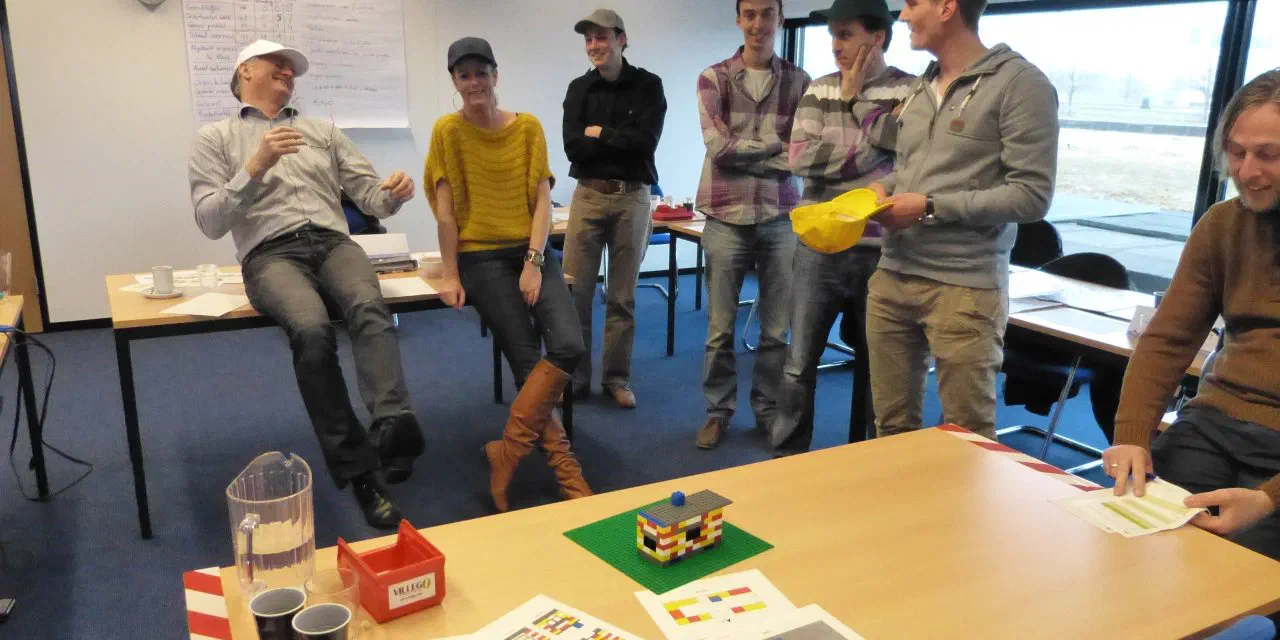
This is the gap the Villego® simulation was built to close. Villego is a Last Planner® System training game in which a project team builds a small villa twice, first the usual way and then with pull planning and weekly commitments, and compares the results. Its sequence runs through Kolb's full cycle twice: round one is the experience, the debrief and the introduction to Last Planner are reflection and theory, and round two is the experiment. You can read how the rounds, roles and scoring work in our simulation guide.
The research is honest about the limits. When Warcup and Reeve (2014) studied the simulation with students and construction professionals, 17 of 24 respondents (71%) said they'd use parts of the Last Planner System right away. But participants also said they'd need more learning to implement it fully, and the authors recommended further guidance. So a good simulation day is a strong start, not a finished implementation, and your workshop design should plan for what happens after it.
Start from the behavior you want to change
Most workshop briefs start with topics: "cover pull planning, PPC and the constraint log." That's the wrong starting point, because topics don't tell you what success looks like.
Start instead with two or three behaviors you'd be able to see on the project within a month. Write each one so that a stranger walking into your weekly planning meeting could check it.
| Weak goal | Observable behavior | How you'd check it |
|---|---|---|
| "Understand Last Planner" | Every trade foreman brings their own weekly commitments to the meeting | Count foremen who arrive with a written plan |
| "Learn about constraints" | Each constraint on the log has one named owner and a date | Review the log on Friday |
| "Improve reliability" | Foremen say no to work that isn't ready, and explain why | Note refusals and their reasons in the meeting minutes |
This changes the design. If the first behavior matters most, round two of the simulation has to give every subcontractor real practice making a promise in front of the group. If the third matters, the facilitator has to praise the first person who refuses an unready task, even when it slows the round down.
Glenn Ballard called the people who directly supervise the work, usually trade foremen, the "last planners" (Ballard, 2000), because their weekly decisions are the last step before work happens. A workshop that doesn't change what last planners do on Monday hasn't changed the planning system.
Pick the format: one, two or three days
How long should a lean workshop be? Long enough to complete the experience-reflection-practice cycle at least once, and short enough that the right people can attend. For trade foremen, every day off site has a real cost to their own companies.
| Format | What it includes | Best for | Trade-off |
|---|---|---|---|
| One day | Villego (both rounds, Last Planner introduction, debrief) plus a short bridge to the project | Project kick-offs, mixed teams meeting for the first time | Little time for lean basics outside Last Planner |
| Two days | Day 1: lean introduction with exercises on systems thinking, root cause analysis and creating flow. Day 2: Villego | Company-wide lean construction training | Harder to get trade foremen for two days |
| Three days | The two-day program plus a real pull planning session on the project's first milestone | Large projects about to start, owners who want a strong launch | Needs the actual project team and real schedule data ready |
The Villego manual suggests exactly this kind of combination, pairing the simulation with exercises such as the essence of systems thinking, root cause analysis, creating flow, micro zoning and milestone planning. Our view: if you can only get one day with the full team, spend it on the simulation and the bridge to the project. Lean theory can be taught later in short sessions. The shared experience can't.
A one-day lean workshop agenda that works
Here's a one-day agenda built on the timing Warcup and Reeve (2014) describe for the simulation: about two hours per round, one hour of Last Planner introduction and up to an hour of recap.
| Time | Block | Minutes |
|---|---|---|
| 7:30 | Welcome, purpose of the day, roles handed out | 30 |
| 8:00 | Round one: build the villa the usual way | 120 |
| 10:00 | Break | 15 |
| 10:15 | Introduction to the Last Planner System | 60 |
| 11:15 | Lunch | 45 |
| 12:00 | Round two: pull plan and build again | 120 |
| 14:00 | Break | 15 |
| 14:15 | Debrief: compare figures, find root causes | 60 |
| 15:15 | Bridge to the project: first milestone, next meeting, personal commitments | 45 |
| 16:00 | Close |
The blocks add up to 510 minutes, or 8.5 hours on site, of which 360 minutes (6 hours) is the simulation and debrief. That's within the five to seven hours the paper gives for the simulation portion.
Two design choices in this agenda matter more than they look. Lunch comes after the Last Planner introduction, not after round one, so people talk about the new ideas over lunch while round one is still fresh. And the last 45 minutes belong to the real project. If you cut anything, don't cut that block.
Who to invite, and in what mix
Workshops often fill up with the people who are easiest to release: project engineers, assistant PMs, maybe the owner's representative. The trade foremen, who make the weekly promises, are the hardest to get and the most important.
Say a general contractor in Charlotte, North Carolina, is starting a five-story medical office building with 12 trade partners. Inviting all 12 trade foremen plus the superintendent and one project engineer gives 14 people, which fits one Villego kit (a kit serves 7 to 15 participants). If the owner's representative and the architect want to attend, make them observers in round one. They'll see the cost of late decisions from a seat where they can't fix it.
Three rules for the mix:
- Invite the people who'll plan the real work together. A workshop with the right companies but the wrong individuals builds no working relationships.
- Mix companies at every table. If the mechanical and electrical foremen sit together, they'll practice the handoffs they'll need on the job.
- Pay attention to who pays for the day. Trade partners lose a day of supervision. Some general contractors cover the foremen's time, and it sends a clear message about how seriously the workshop is meant.
Room setup and materials
A lean workshop built around a simulation needs more space than a lecture. For Villego, the room needs at least 3 meters (10 linear feet) of clear wall for planning forms and at least 4 square meters per person.
For the 14-person team above, that's 14 × 4 = 56 square meters, or about 603 square feet (at 10.76 square feet per square meter). A site trailer won't do it. A hotel meeting room or your company's training room with movable tables usually will.
Check the details the day before:
- the planning wall is smooth and sticky notes will stay up on it
- the laptop, projector and timer work, and the timer is visible from every table
- tables can be moved between rounds, because round two often needs a different layout
- there's a flipchart for the scores where everyone can see it
The Villego kit page lists everything the kit contains and what you need to add.
Facilitating so people talk more than you do
The facilitator's hardest job in round one is to let things go wrong. When subcontractors crowd the build area or wait for material, the instinct is to step in and help. Don't.
There's good evidence for holding back. Manu Kapur (2008) ran an experiment in which students who first struggled with complex, poorly defined problems in groups, without support, produced weak solutions. But they then outperformed students who had worked on well-structured problems on later individual tests, including problems different from the ones they had practiced. Kapur called this "productive failure." Round one of a simulation works the same way: the struggle is what makes the Last Planner introduction land.
In round two, the job changes. Now you're coaching conversations. Listen for vague promises ("we'll try to get there Tuesday") and ask the receiving trade whether that's good enough for them to start. Listen for handoffs nobody has agreed. And keep your own talking time short in the debrief. A useful rule of thumb is that participants should speak for at least two-thirds of the debrief hour (about 40 of the 60 minutes), because conclusions people reach themselves are the ones they defend later on site.
The facilitators in the Warcup and Reeve (2014) study found that teaching percent plan complete was one of the most important elements of the weekly planning sessions. So count the promises in round two and show the share kept. Our guide to percent plan complete explains the measure in full.
Measure the workshop the way you'd measure a project
How do you know whether a lean workshop worked? Feedback forms tell you whether people enjoyed it. That's the first of Donald Kirkpatrick's four levels of training evaluation: reaction, learning, behavior and results (see Wikipedia's summary of the Kirkpatrick model). The same summary notes that trainers often get stuck at the first two levels and never measure the last two, where the useful data are.
For a lean construction workshop, the four levels translate like this:
| Level | Question | What to measure |
|---|---|---|
| Reaction | Did people find it relevant? | A five-question survey at the end of the day |
| Learning | Can they do it? | In round two, can each foreman make a specific promise with a clear handoff? |
| Behavior | Do they do it on site? | The observable behaviors you chose at the start, checked weekly for six weeks |
| Results | Did planning get more reliable? | PPC and milestone dates over the first six to eight weeks |
Say the team's first weekly work plan after the workshop holds 40 commitments and 26 are completed as promised. That's a PPC of 26 ÷ 40 = 65%. The number on its own says little. The trend over the next six weeks, and the reasons behind each miss, tell you whether the workshop changed how the team plans.
Plan the first two weeks after the workshop
Hermann Ebbinghaus's experiments on memory, published in 1885, produced what's now called the forgetting curve: without review, newly learned material fades quickly, and each repetition slows the decline (see Wikipedia on the forgetting curve). Ebbinghaus studied nonsense syllables, not planning habits, so don't stretch the comparison too far. But any superintendent who has watched a good workshop fade by the third week will recognize the shape.
So schedule repetition before the workshop day, not after it:
- Within a week: run the project's first real pull planning session on the first milestone, with the same people who built the villa.
- The following Monday: hold the first weekly work plan meeting, using the same promise language people practiced in round two.
- Every day: a short daily huddle at the planning board, so commitments are checked while they can still be rescued.
- At the end of week two: review PPC and the reasons for variance with the whole team, and refer back to the villa ("this is round one behavior") when it helps.
If you can't schedule step 1 before the workshop, consider postponing the workshop. A simulation without a real planning session to follow it is entertainment with good intentions.
A lean workshop is judged on the second Monday
The round two score and the feedback forms tell you little. The best test of a lean workshop is the second weekly planning meeting after it. By then the novelty has worn off, and the team is back under schedule pressure. If foremen arrive with their own commitments, refuse unready work and talk to each other instead of to the superintendent, the workshop worked. Design every hour of the day around making that meeting happen, and book it before you book the room.
Sources
- Robert Warcup and Edward Reeve (2014). Using the Villego® Simulation to Teach the Last Planner® System. Lean Construction Journal, pp. 1-15
- Manu Kapur (2008). Productive Failure. Cognition and Instruction 26(3), pp. 379-424
- Wikipedia (2026). Experiential learning (Kolb's experiential learning model).
- Wikipedia (2026). Donald Kirkpatrick (Kirkpatrick model of training evaluation).
- Wikipedia (2026). Forgetting curve.
- Glenn Ballard (2000). The Last Planner System of Production Control. PhD thesis, University of Birmingham