
Friday's review shows another missed drywall commitment. The reason says “inspection.” Last week's reason said the same thing. You've recorded the miss, but nothing has changed in the way work becomes ready.
Root cause analysis construction teams can use starts with that specific gap between a promise and its outcome. Evidence should support every causal link. You then test a change that should prevent recurrence. The useful result is a different planning decision next week, not a longer explanation of last week.
Root cause analysis construction teams can act on
“Not enough labor” doesn't tell you why a crew arrived short. Was capacity overcommitted? Did another project pull workers away? A category describes the immediate difficulty; root cause analysis examines the process that allowed it to interrupt a promise.
In the Last Planner® System (LPS), this investigation belongs in the learning conversation after weekly commitments are reviewed. You don't need a formal investigation for every small miss. You do need reliable facts and a way to bring the findings back into planning.
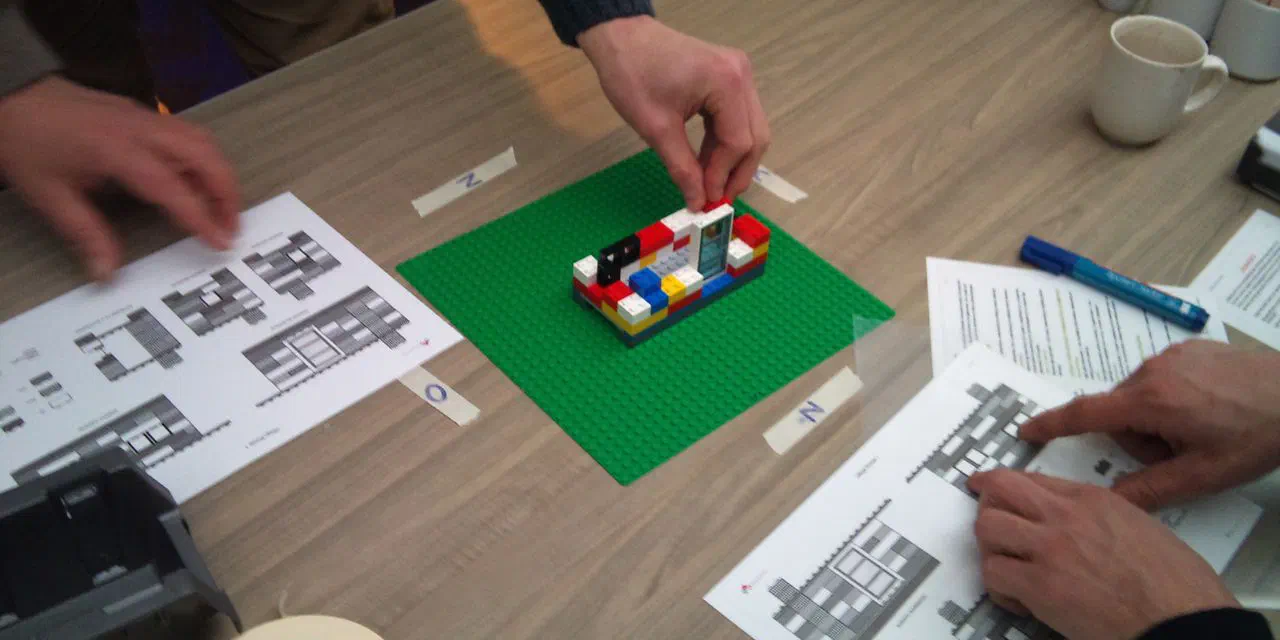
Villego® is a hands-on Last Planner System simulation in which a project team builds a small house, or “villa,” from small bricks in two rounds: first the usual push way, then the Last Planner way. Observers record construction time, waste, safety, productivity, and Percent Plan Complete (PPC), the percentage of weekly promises completed as agreed. Facilitators can let participants practise root cause analysis during the simulation. Warcup and Reeve (2014) describe participants working with 5 whys and countermeasures. That gives you a place to rehearse asking questions without making a real crew's missed deadline the first practice attempt.
The distinction matters on site. Rescheduling today's blocked work is recovery. Changing the readiness check that let blocked work into the plan is prevention. You'll often need both.
Record reasons for variance before choosing an investigation
Say a general contractor in Columbus, Ohio, is building a hypothetical four-story medical office building with 14 trade partners. The team completes 18 of its 24 weekly commitments. Its Percent Plan Complete calculation is 18 ÷ 24 × 100 = 75%, leaving six missed promises to understand.
PPC tells you how reliably the team delivered. It doesn't explain the misses. Reasons for variance are recorded explanations for why promised work wasn't completed as agreed. Your record needs the original task and its location, the promised finish time, and a factual account of what happened instead.
Here's a practical starting set of categories, not a universal coding standard:
| Reason category | Specific detail worth recording |
|---|---|
| Design or information | A wall detail remained unresolved at the promised start. |
| Materials | The required valve size wasn't delivered to the work area. |
| Predecessor work or handoff | In-wall plumbing lacked its required inspection release. |
| Labor or capacity | The committed crew was reassigned before the task started. |
| Equipment, access, or space | A shared lift wasn't available during the agreed window. |
| Quality or rework | Rejected rough-in work prevented wall closure. |
| Weather or external conditions | Wind stopped the planned lift under the project's safety rules. |
| Planning or scope | The promise omitted part of the agreed completion criteria. |
Agree what each code means. Keep the factual description too, because “materials” can cover unrelated failures that need different changes.
Mossman (2020) recommends examining individual reasons rather than treating a whole category as one root cause. His frequency-ranked Pareto chart helps you choose where to investigate. You can use that pattern to choose investigations, but don't let frequent minor misses outrank an infrequent problem with serious consequences.
Use the 5 whys to trace one missed promise
In the Columbus example, one promise was to hang 1,200 square feet of corridor drywall in Zone B by Friday at 3 p.m. The required release was missing. The crew couldn't close the walls. Record inspection as the initial reason, not the final answer.
Taiichi Ohno (1988), in Toyota Production System: Beyond Large-Scale Production, describes repeated why questions as a way to clarify a problem and its solution. Wikipedia's Five whys entry (2025) explains that each question follows the previous answer. The questions should expose a causal chain rather than produce five guesses.
For this hypothetical case, suppose the booking record, weekly plan, and conversations with both foremen support this sequence:
- Why wasn't the drywall commitment completed? The walls couldn't be closed without the required inspection release for the in-wall plumbing.
- Why wasn't the release available? The inspection request was submitted too late to obtain the Thursday appointment needed for Friday's closure.
- Why was the request late? The plumbing foreman expected the superintendent to submit it; the superintendent expected the plumbing foreman to do so.
- Why did they have different expectations? Their zone handoff tracked rough-in completion but didn't identify who would request the inspection or confirm acceptance.
- Why was that missing from the handoff? The make-ready process treated inspections as follow-up administration, so its readiness criteria omitted inspection ownership, booking lead time, and release evidence.
Now you have a changeable cause. The project let a closure promise proceed without a defined inspection pathway. Asking the drywall foreman to work faster won't repair that gap.
Check the causal links against dates. If the request was actually submitted on time, this chain fails and you'll need to investigate another branch. We shouldn't defend an explanation once the evidence contradicts it.
Five isn't a stopping rule. You may need fewer questions or more. Stop when you've found a supported condition that you can change and explain how that change would interrupt the failure sequence. Don't stop at “someone forgot.”
Use a fishbone when several explanations remain plausible
Suppose Zone B also had a missing wall detail and a congested corridor. That changes the investigation. It isn't enough to follow whichever explanation the superintendent mentions first.
Wikipedia (2025) describes the Ishikawa diagram, also called a fishbone diagram, as a way to group potential causes of a particular effect. Named for Kaoru Ishikawa, it places the problem at the head and possible causes on branching ribs.
For your review, put the exact missed promise at the head. You can adapt the branches to the variance categories above, then add observed conditions and questions beneath each branch. The labels should help the trades contribute, not force site problems into manufacturing terminology.
Mark which ideas have evidence. You'll otherwise get a tidy picture of assumptions. Follow supported branches with why questions, and retain multiple causes if the facts require them.
A short event timeline helps too. Compare the booking date with the promised handoff. Ask what changed from the previous successful zone and which readiness check failed to catch it. Those comparisons can expose a missing link that brainstorming won't.
Keep blame out without removing accountability
“The plumbing foreman let us down” closes a conversation before it explains anything. Your foreman may defend the crew instead of describing how the booking responsibility became unclear. Then the same ambiguity survives into the next zone.
You can start with the promise and the sequence of events, using neutral language. Ask what information was available when the commitment was made, and what check would have revealed the risk. Invite the people who did the work and those controlling the prerequisite, not just their managers.
Tone changes the evidence you receive. “Why didn't you book it?” sounds like a charge. “How did we decide who would book it?” makes the coordination process available for examination. You still need to establish what actually happened.
Don't confuse respectful inquiry with letting commitments disappear. The inspection action needs a named owner and an agreed date. If that owner can't deliver, the team needs early notice and a renegotiated commitment. The general contractor's actions belong in the record too.
Keep contract disputes separate from this learning discussion. And a weekly variance review doesn't replace a formal safety or technical investigation when one is required. Secure the work first; unresolved hazards aren't an acceptable price for improving PPC.
Use A3 thinking to carry the evidence into a decision
A meeting can end with a convincing explanation that nobody acts on. In Columbus, “improve inspection coordination” could remain on the minutes while the next corridor repeats the same miss. It's too vague to test.
Wikipedia (2024) describes A3 problem solving as a structured improvement approach typically captured on one A3-size sheet. That helps when several trades disagree.
Your working A3 can record the missed promise, evidence, supported causes, proposed countermeasure, owner, and review date. Include the expected result before testing it. You don't need a polished report for every miss; a brief variance record may be enough for a local issue.
A3 thinking helps when agreement is difficult. The plumbing and drywall foremen can inspect the same reasoning and challenge the proposed change before it becomes a new rule.
A countermeasure is complete only after the next handoff tests it
Booking the delayed inspection lets today's drywall work recover. It doesn't protect the next zone. The next handoff must test the change.
In this hypothetical project, the superintendent could own an inspection-readiness check before future closure tasks enter the weekly work plan. It would identify the inspection requester, confirm local booking requirements, and require evidence of the necessary release. The plumbing and drywall foremen would agree what constitutes an accepted handoff.
You can put unresolved inspection actions into the constraint log, the record of blockers, owners, and promised removal dates. That feeds the finding into make-ready, the process of clearing prerequisites before work is committed. “Remind everyone” doesn't give the planner a dependable readiness test.
There's a trade-off here. Requiring release evidence before committing closure work may reduce what you can promise this week. If the release isn't available, choose ready alternative work from your workable backlog, the prepared tasks crews can do without disrupting other trades. Don't conceal the miss by changing last week's finish criteria.
Test the check on the next comparable zones. Record whether each release was verified before commitment and whether inspection readiness again prevented closure. Keep PPC in view, but don't treat a higher project-wide score as proof that this particular change worked.
If the same failure returns, reopen the cause analysis. If it doesn't return, check that crews actually used the new process rather than benefiting from easier conditions. Then adopt the check for similar handoffs. A completed variance review should leave your next planner with better evidence for making a promise.
Sources
- Robert Warcup and Edward Reeve (2014). Using the Villego® Simulation to Teach the Last Planner® System.
- Alan Mossman (2020). Last Planner: 5 + 1 crucial & collaborative conversations for predictable project production planning.
- Taiichi Ohno (1988). Toyota Production System: Beyond Large-Scale Production.
- Wikipedia (2025). Five whys.
- Wikipedia (2025). Ishikawa diagram.
- Wikipedia (2024). A3 problem solving.