
The drywall crew arrives to close a corridor, but the electrical inspection hasn't happened. Yesterday's update sounded reassuring, yet nobody checked whether the promised corridor handoff was ready for the drywall crew to start work. A daily huddle should catch that gap.
On a construction site, this is a 10 to 15 minute stand-up at the planning board. Each foreman reports what is done, what isn't done, and what is at risk tomorrow. You need decisions people can act on.
What should a daily huddle accomplish?
Say a general contractor in Toledo, Ohio, is building a hypothetical four-story medical office with eight active trade crews. The superintendent knows the schedule, but the mechanical foreman knows a delivery has slipped. The Last Planner® System needs that information shared between the people whose work depends on it.
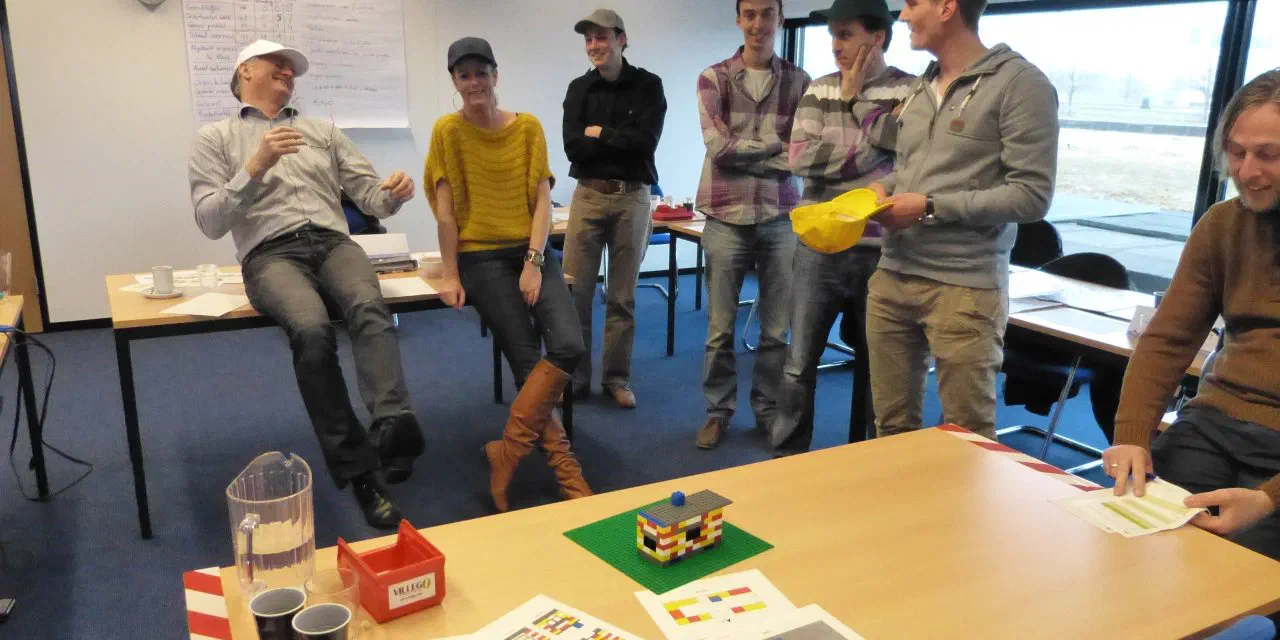
Villego® is a hands-on Last Planner System simulation in which a project team builds a small house, or “villa,” from small bricks in two rounds. First comes the usual push way, then the Last Planner way. Observers record construction time, waste, safety, productivity and PPC, or Percent Plan Complete. That comparison gives your team a shared reference for discussing why a busy crew can still leave the next trade waiting. A site huddle applies the same attention to dependencies, using actual commitments.
Wikipedia (2025), in its April 30 revision of “Stand-up meeting,” describes meetings usually timeboxed to 5 to 15 minutes and emphasizes communication between team members rather than status updates to management. For a daily huddle, construction teams need a board showing the promises they're checking, not just a list of trades attending.
Ballard and Tommelein (2021) define LPS daily huddles as brief meetings of interdependent participants who share completed commitments and those they need help with or cannot deliver. That's the purpose to protect. General announcements can go elsewhere.
Who attends, and where should you stand?
A project manager saying “electrical is fine” can't answer whether the corridor inspection passed. You need the foreman who can commit that crew's work, or an informed representative with equivalent authority. Attendance should follow the handoffs.
Your core group is the superintendent and foremen of active, interdependent trades. A lean coordinator can facilitate and record actions, but shouldn't speak for crews. Bring in a logistics lead or project engineer when a shared lift, delivery or unresolved design question affects the day's work. Other workers need their own crew briefing; they don't all need to attend the trade-coordination huddle.
Meet at the current planning board. Keep a marked-up floor plan beside it. A sheltered field location close to the work is preferable if people can hear each other safely. A noisy loading dock isn't useful. Keep the meeting clear of vehicle routes, and provide seating for anyone who needs it. Brevity shouldn't depend on physical discomfort.
Choose a fixed time on each working day. An afternoon huddle gives you time to protect tomorrow's starts; a morning huddle checks yesterday and confirms today. On a large site, separate huddles by genuinely independent work areas, with a named person carrying shared logistics issues between them. Don't split crews that need to negotiate the same handoff.
A 15-minute agenda that checks commitments
In the Toledo example, an open question such as “How's everybody doing?” invites long narratives. Eight foremen can fill the meeting before anyone mentions the missing inspection. A fixed sequence makes space for every trade and keeps the discussion connected to the board.
Here's a suggested agenda for that hypothetical eight-foreman group:
- Open and orient, 1 minute. The facilitator points to today's due commitments and tomorrow's starts. Flag any immediate hazard or changed access condition that affects the work.
- Foreman round, 8 minutes. Each foreman has about 60 seconds to identify completed commitments, incomplete work and the next promised handoff. State today's remaining work and whether tomorrow's commitment is still feasible.
- Tomorrow's risks and coordination, 4 minutes. Confirm the affected trade, location and prerequisite for each risk. Agree a quick adjustment where possible, or assign the people who must resolve it after the huddle.
- Read back actions, 2 minutes. Confirm each action's owner, deadline and affected commitment. Check that receiving trades understand any changes, then close.
The allocation is 1 + 8 + 4 + 2 = 15 minutes. It's a working limit, not evidence that every project needs precisely eight speakers. Smaller groups may finish in 10 minutes. If yours repeatedly can't finish within 15, review preparation and work-area grouping before giving everyone another meeting.
Alan Mossman (2020) describes the production-management conversation as generally no more than 15 minutes. His foreman prompts ask what was delivered, which promises will be late or early, and what concerns or constraints need attention. Upcoming completions need checking too. Use those questions to test commitments.
Report done, not done, and tomorrow's risk precisely
“We're nearly finished” doesn't tell the drywall foreman whether to bring a crew into the corridor. In the hypothetical project, the electrical commitment might be “Level 2 east corridor rough-in accepted and released by Tuesday afternoon.” Installation alone doesn't meet that promise if acceptance remains outstanding.
A useful report sounds like this: “Rough-in is installed. The corridor release isn't done because the inspection is pending. I need confirmation by 2 p.m. to protect drywall's start tomorrow.” The receiving foreman then confirms what they need. This makes the handoff, meaning the transfer of ready work to the next trade, explicit.
Mark completed commitments only when they meet the agreed acceptance conditions. Record incomplete ones with their reason and a recovery forecast. An at-risk mark is an early warning about future work, not proof that a promise has already been missed. Written labels matter (color alone can be misunderstood).
At an afternoon huddle, distinguish “done” from “forecast to finish today.” You can update the latter after verification. Don't award partial completion credit to make the board look better. And if a trade finishes early, check whether the successor is ready before moving work forward; early work can consume space another crew needs.
Link the board to the weekly plan and constraint log
A new promise scribbled onto the board can quietly erase yesterday's missed one. That makes the meeting appear successful while the team loses the information needed to improve its planning.
Keep the weekly work plan as the record of agreed commitments, with the original due dates visible. Add actual completion and revised forecasts alongside it. Daily adjustments should be agreed with affected trades, and added work should be identified as added work. You shouldn't rebuild the entire week during every huddle.
When a foreman raises a blocker, connect it to the constraint log, the record of obstacles and responsibility for removing them. In the Toledo example, the log entry needs the corridor commitment, inspection dependency, a named owner and the deadline for confirming the inspection. “GC to handle” isn't an owner. The next check should establish whether the constraint was removed, not merely whether someone sent an email.
Some issues need longer preparation. If a design response won't arrive in time, feed that information into look-ahead planning and make-ready work, where upcoming tasks are screened and prepared before crews promise them. If today's task cannot proceed, consider the workable backlog: ready alternative work that won't disrupt another trade. Confirm access and resources before redirecting the crew.
Daily records also support Percent Plan Complete and weekly learning. Capture reasons for variance, meaning why actual delivery differed from the promise, while memories are fresh. You won't remember every conversation on Friday.
Keep problem solving outside the short meeting
Two foremen arguing over a duct route can leave everyone else waiting at the board. But cutting them off without a follow-up agreement leaves the obstruction untouched. “Take it offline” needs an owner and a time.
The facilitator can say, “Mechanical and electrical will check the route with the project engineer immediately afterward and report the decision by noon.” Everyone else returns to work. A short clarification belongs in the huddle; drawing review and detailed resequencing usually don't.
Foremen should check progress before arriving. Use the same speaking order so nobody waits to be called on, and have a prepared substitute when a foreman is absent. Once the group knows the routine, foremen can take turns facilitating, so the meeting doesn't depend on a single organizer. The huddle shouldn't disappear because the superintendent is elsewhere.
If reporting bad news earns a public dressing-down, you'll hear fewer warnings. Ask what changed and what help is needed. Accountability still matters: the person accepting an action reports whether it happened. Blame doesn't make tomorrow's work ready.
How does it differ from a safety toolbox talk?
Imagine the coordination huddle identifies overhead work above a planned delivery route. That issue affects production and safety, but a quick route change doesn't teach the crew how to perform the overhead task safely.
A safety toolbox talk focuses on a hazard and the safe practices workers need for their task. The production huddle checks commitments and interfaces between crews. Both may be short and held before work, but they need different content and often different participants.
Keep their agendas distinct, even if they happen consecutively. Workers who need task-specific instruction shouldn't lose it because foremen spent the allotted time discussing deliveries. Equally, attendance at a safety talk doesn't confirm that trade handoffs are ready. Neither meeting replaces required training or task planning.
Immediate hazards need immediate action. Don't defer an unsafe condition to tomorrow's board review or wait for the next toolbox talk.
Tomorrow's handoff is the test of today's huddle
If tomorrow's drywall crew still arrives without knowing whether the corridor is released, today's meeting hasn't achieved its purpose. A full attendance sheet won't change that.
Start with your current weekly commitments and test this routine for one working week. Notice whether foremen report risks early, actions get closed and receiving trades know what they can start. Which discussion wasted the group's time? Then change the agenda accordingly.
Keep the 10 to 15 minute limit. Protect the conversation that lets people say a promise is in danger while there's still time to act. That's what makes the daily check useful to the weekly plan.
Sources
- Wikipedia (2025). Stand-up meeting.
- Alan Mossman (2020). Last Planner: 5 + 1 crucial & collaborative conversations for predictable project production planning.
- Glenn Ballard and Iris D. Tommelein (2021). 2020 Current Process Benchmark for the Last Planner® System of Project Planning and Control.