
Your drywall crew is ready. The above-ceiling inspection isn't. Asking the foreman to pick up the pace won't release that workface, and moving the crew somewhere else means another setup before productive work resumes.
Construction productivity improves when more paid hours produce completed, acceptable work. Where crews face repeated interruptions, your first priority should be reliable weekly plans rather than pressure to install faster. That means choosing work that can actually proceed, agreeing handoffs between trades, and learning why promises fail. Better tools and craft skills still matter. But they can't compensate for a missing prerequisite.
Start with work crews can actually perform
Say you're managing a hypothetical four-story medical office building in Columbus, Ohio, with 14 trade partners. Monday's schedule calls for ceiling closure, but the mechanical foreman knows testing won't finish until Wednesday. A date on a schedule doesn't resolve that conflict.
The Last Planner® System, a registered trademark of the Lean Construction Institute, addresses this through collaborative production planning. Your last planner is the person closest to the work who can commit a crew, usually a foreman. They help determine what can be completed, rather than accepting an untested assignment.
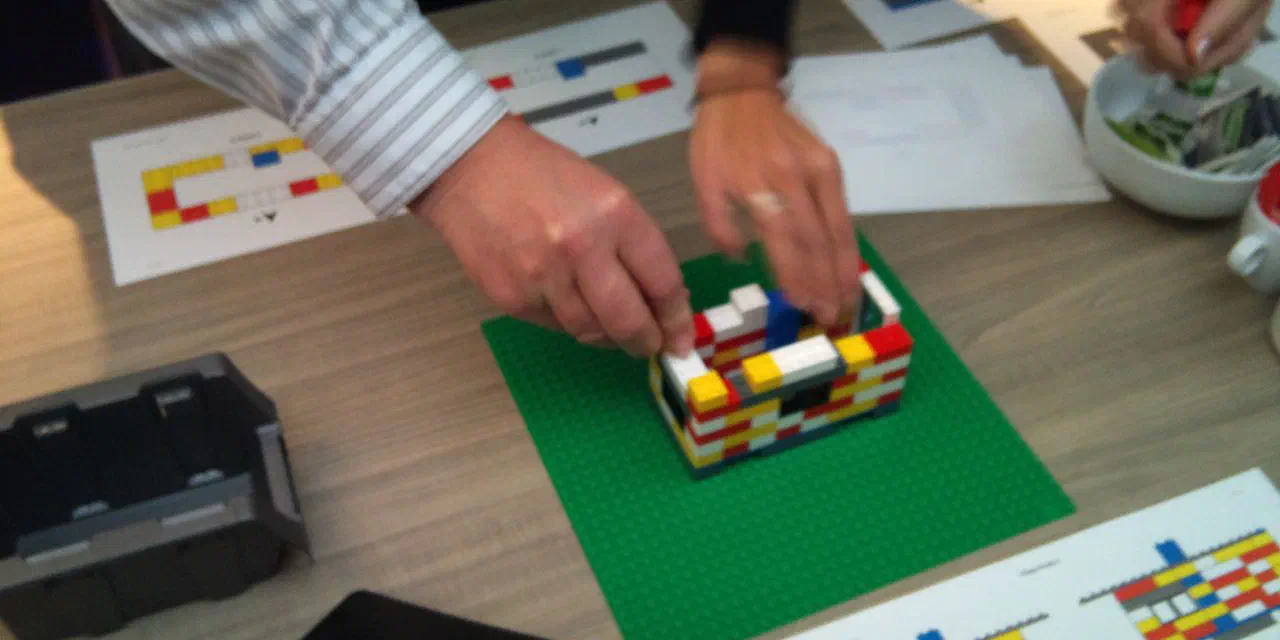
Villego® is a Last Planner System simulation in which a project team builds a small house, or “villa,” from small bricks in two rounds: first the usual push way, then the Last Planner way. Observers record construction time, waste, safety, productivity and Percent Plan Complete (PPC), the share of promised tasks completed as agreed.
That comparison gives your team a practical question to discuss: which changes helped work flow? On the Columbus example, the useful change would be an agreed inspection and testing handoff before ceiling closure. The drywall crew shouldn't have to discover the problem after mobilizing.
What US construction productivity data actually says
A national chart can mislead you. It can't tell you why a crew waited for a lift yesterday. You'll need project-level evidence for that decision, rather than blaming individual workers for a sector trend.
Goolsbee and Syverson (2023), in The Strange and Awful Path of Productivity in the U.S. Construction Sector, report that construction value added per worker was about 40% lower in 2020 than in 1970. Their labor measure uses full-time-equivalent employees, not your crew's timecards. They also examine physical housing output and conclude that measurement error probably isn't the sole explanation for stagnation.
The picture varies by industry and method. Sveikauskas, Rowe, Mildenberger, Price and Young (2018), in the BLS article Measuring productivity growth in construction, estimate annual labor productivity growth of 1.1% for single-family construction and 3.7% for multifamily construction over 1987–2016, controlling for housing-start cycles. Those central estimates exclude subcontractor hours; the article separately examines their inclusion.
These findings aren't interchangeable. They use different output definitions, labor inputs and periods. Neither establishes that unreliable weekly plans caused the national trend. Your practical response is to measure comparable work packages on your own project, including the hours spent waiting or correcting work. Don't turn a sector statistic into a crew target.
Reliable handoffs protect labor productivity downstream
On the hypothetical Columbus project, a plumbing crew finishes most rough-in work in several rooms but leaves each room incomplete. The total installed footage may look respectable. The next trade still can't start cleanly anywhere.
Ballard and Howell (1998), in Shielding Production: Essential Step in Production Control, explain how assignments selected for soundness, sequence and size protect crews from workflow uncertainty. Soundness means prerequisites are available. Sequence means the work fits downstream needs. Size means the crew can complete it within available capacity.
Thomas, Horman, Minchin and Chen (2003), in Improving Labor Flow Reliability for Better Productivity as Lean Construction Principle, examine three bridge projects. Their findings support reliable material, information and equipment availability, but also identify poor labor utilization and the need for better workforce management. Reliable supply alone isn't enough.
You can apply both lessons by planning complete zones and matching crew capacity to ready work. A handoff is the agreed transfer of a usable work area to the next trade. “East wing rough-in complete and accepted by Tuesday” is more useful than “continue rough-in.” It gives the successor a basis for staffing. Otherwise, they won't know what to expect.
Waiting and rework hide inside paid hours
A timecard can show a full week without explaining what happened. On our hypothetical project, four installers each work 40 hours, giving 4 × 40 = 160 labor-hours. Suppose 40 hours go to waiting and rework, leaving 120 hours for acceptable installation.
Assume the crew completes 640 square feet. Labor productivity is 640 ÷ 160 = 4 square feet per paid labor-hour. If reliable releases reduce lost time to 10 hours, 150 installation hours at the same installation rate produce 800 square feet: 640 × 150 ÷ 120 = 800. Then 800 ÷ 160 = 5 square feet per labor-hour, a gain of (5 ÷ 4 − 1) × 100 = 25%.
Nobody installs faster in this example. It's an illustration, not a forecast, and it assumes comparable conditions and unchanged quality. It shows why recovering interrupted time can matter more than pushing hand speed.
Your records should separate waiting from rework. Waiting needs a release condition, such as an inspection or material delivery. Rework needs a different question: what allowed the error to reach installation before anyone challenged it? Count accepted quantities once, while keeping correction hours in the denominator. Otherwise you'll reward doing the same work twice.
How do you measure lost time without a stopwatch on every crew?
Most foremen know their crew waited "a lot" last week. Few can say whether that was 5% or 25% of the paid hours. And the guess usually depends on the worst afternoon, not the average one.
Work sampling gives you a cheaper answer. Wikipedia's work sampling article describes it as a statistical technique for estimating the share of time workers spend in defined categories of activity, using many observations taken at random times. It was developed for manufacturing, but the same article lists construction among its later applications. Practitioners also call it activity sampling or a ratio delay study.
Here's how a two-week baseline might look on the hypothetical Columbus project:
- Define five categories before you start. For example: direct installation, preparation (layout, setup, material handling), waiting, travel within the site, and rework. Agree what each one means with the foremen, so two observers would code the same moment the same way.
- Tell the crews what you're doing and why. The Wikipedia article includes informing everyone affected as a standard step. Record categories, not names. You're studying the system, and a study that feels like surveillance will change behavior while you watch.
- Walk at random times. Say you make eight rounds a day across 10 working days and observe a five-person crew each time: 8 × 10 × 5 = 400 observations. Random times matter because a walk at 7:15 every morning will catch setup every time.
- Calculate the share and its margin of error. If 72 of the 400 observations show waiting, the waiting share is 72 ÷ 400 = 18%. At 95% confidence the margin of error is about 1.96 × √(0.18 × 0.82 ÷ 400) ≈ 3.8 percentage points. So the true share is probably between roughly 14% and 22%.
How many observations are enough? The worst case is a share near 50%. For a margin of ±5 points at 95% confidence, you need 1.96² × 0.5 × 0.5 ÷ 0.05² = 384.16, rounded up to 385 observations. Tighten the margin to ±4 points and the figure rises to 601. Most site teams can live with ±5 points for a baseline (you're looking for big, recurring losses, not decimals).
A word of caution. Work sampling measures where time goes. It doesn't measure output, and a high share of direct installation can still produce work that fails inspection. Use the waiting and rework categories to choose which constraint to attack first, then confirm the effect through accepted quantities.
Then repeat the same sample after the fix. Suppose the second two-week round finds 44 waiting observations out of 400, or 11%, with a margin of about ±3.1 points. The first range ran from about 14.2% to 21.8%; the second runs from about 7.9% to 14.1%. Because the two ranges don't overlap, you can tell the crew with some confidence that waiting dropped, which is a far stronger message than "it feels better out there."
Build a weekly plan that protects the workface
“Install ceilings next week” doesn't tell the foreman which rooms are available or whether the crew has enough capacity. A crowded planning board isn't proof of readiness.
Your weekly work plan should select commitments from work you've made ready. Make-ready means removing prerequisites that would prevent a task from starting or finishing. A useful planning sequence is:
- Confirm the required handoff. The receiving foreman explains the location, acceptance criteria and due date. On the Columbus example, that includes completed testing and the required inspection before closure.
- Check readiness before accepting a promise. Your look-ahead schedule should expose missing information, materials, access, equipment and predecessor work early enough to act. A constraint log records each blocker, its responsible person and the needed resolution date. “Ordered” doesn't mean available at the workface.
- Match the commitment to capacity. The foreman checks staffing against realistic production rates and the available work area. Include setup and required safety controls. If the proposed work won't fit, the team needs a different sequence or an explicit recovery decision, rather than a promise nobody believes.
- Prepare a workable backlog. This is ready alternative work your crew can switch to if a commitment becomes blocked. It shouldn't interfere with another trade or create premature work that you'll later remove.
A daily conversation checks those releases. You don't need to recreate the whole weekly plan each morning. You do need to warn the next trade when a promise is at risk, because they can adjust before losing a shift.
This takes preparation outside the meeting. If every constraint first appears at the weekly session, you'll spend the hour discussing problems you can't resolve there.
Measure improvement without rewarding easy promises
Suppose the Columbus team completes 16 of 20 promised tasks. Its Percent Plan Complete is 16 ÷ 20 × 100 = 80%. That measures promise reliability. It doesn't measure installed quantity or labor efficiency, since a small task and a large task each count as one commitment.
Mossman (2020), in his Last Planner planning guide, warns that PPC is easily manipulated when used for purposes other than learning. You'll learn little from a high score achieved by promising only easy work while critical handoffs slip.
For construction productivity improvement, review PPC beside accepted output per labor-hour, lost hours, and milestone progress. Don't substitute one for another. Keep the original commitments visible, so late changes don't erase missed promises.
Compare work packages with earned hours
PPC can't tell you whether 80% reliability came with good labor output. Earned hours can. The method borrows from earned value management, which Wikipedia describes as a technique that compares the budgeted value of work actually completed with its actual cost. On a crew level, you swap dollars for labor-hours.
Take the drywall example again. Say the estimate allows 0.2 labor-hours per square foot. In the first week, the crew installs 640 square feet, so it earns 640 × 0.2 = 128 hours against 160 paid hours. The productivity factor is 128 ÷ 160 = 0.80. After the release problems are fixed, 800 square feet earns 160 hours, and the factor reaches 160 ÷ 160 = 1.00.
This works because earned hours put different tasks on one scale: a ceiling grid and a wall board both convert to budgeted hours. It only works if the unit rates in your estimate are realistic, though. A factor of 1.3 may mean a great week, or it may mean the estimator padded the rate. Track the factor by work package over several weeks before you draw conclusions, and count only quantities the receiving trade has accepted.
Record reasons for variance, the specific reasons promised work wasn't completed. “Materials late” is too broad. “Specified hangers unavailable because the substitution wasn't approved before ordering” points to an action. Assign that action to someone who can change the process and check whether the same failure returns.
Comparisons need consistent scope. Access conditions and learning on repeated tasks can change productivity independently of planning. A rising PPC alongside rising labor output is encouraging, but it doesn't prove planning caused the entire gain.
Use classroom results to test thinking, not forecast savings
A large training improvement can become an unrealistic field target. Your superintendent shouldn't budget a productivity multiplier just because a team built a model faster on its second attempt.
Warcup and Reeve (2014), in Using the Villego® Simulation to Teach the Last Planner® System, report these round-to-round classroom results:
| Participant team | Round 1, elements/minute | Round 2, elements/minute |
|---|---|---|
| Utah Valley University students | 8.86 | 18.38 |
| Construction professionals, team 1 | 8.19 | 22.09 |
| Construction professionals, team 2 | 8.44 | 20.75 |
These are simulation elements per minute, not field output per labor-hour. The study involved 31 participants across student and professional groups, with the professionals divided into two teams. It wasn't a controlled field trial isolating weekly planning from familiarity or other changes between rounds.
And every measure didn't improve. Professional team 2's waste penalties rose from 16 to 172, while delivery penalties rose from 4 to 5. Your debrief should examine those losses alongside the faster construction. The defensible lesson is to investigate how planning changes production, then test those practices on a live project with its own baseline.
Run a first-run study before repetitive work starts
The first exam room on a floor is where a crew finds out the backing sits in the wrong place, the box sizes don't match the cabinets, and the inspector wants to see the fire caulking before the lid goes on. Too often, the crew solves it alone on room one. Then room two runs into the same problems, because nobody wrote the fix down.
A first-run study treats the first instance of a repeated operation as a planned rehearsal. Lean construction practitioners use the term for a short cycle: plan the method with the people who'll do the work, perform it while someone observes, review what happened, and agree the revised method before the repeats begin. It turns one crew's discovery into the whole floor's standard.
Say the Columbus building has 36 identical exam rooms. The study costs a 90-minute planning and review meeting with six people, 6 × 1.5 = 9 labor-hours, plus 8 hours of observation, so 17 hours in total. If the revised method saves 1.5 labor-hours on each of the 35 remaining rooms, the saving is 35 × 1.5 = 52.5 hours. That leaves 52.5 − 17 = 35.5 hours net, before counting the rework you didn't have to do. (If the rooms aren't truly identical, the saving shrinks fast, so check the drawings first.)
The study works best when the receiving trade joins the review. The painter knows which drywall finish level slows them down, and the inspector's comments belong in the method rather than in a punch list. Record the agreed sequence, crew size, hours and acceptance criteria on one page, and post it where the next room starts.
Better technology needs ready work too
A tablet can show the latest drawing while a crew still waits for access. Prefabricated assemblies can arrive on time but occupy storage because their installation zones aren't ready. Purchasing technology doesn't settle the handoff.
Your team can connect digital documents and building information modeling to specific readiness checks: approved details, installation clearances and resolved conflicts. Material staging and equipment maintenance should follow the same work packages. If a tool doesn't change a production decision, you shouldn't assume it improves output.
Craft training remains necessary when crews lack a skill. Foremen also need practice negotiating commitments and raising bad news without blame. Where installation itself is the bottleneck, better methods or equipment may offer more benefit than another planning meeting. Reliable workflow helps you see that distinction.
Give crews ready work before asking for more speed
If next Monday's plan still includes an uninspected ceiling zone, a higher production target won't fix the release. You can't coach a crew through a missing prerequisite.
Your next improvement should address a named interruption, with someone responsible for clearing it before work begins. Then compare accepted output and paid hours across similar work. Protect safety and quality throughout. Faster installation has value once the work is ready, but dependable weekly commitments give that speed somewhere useful to go.
Sources
- Austan Goolsbee and Chad Syverson (2023). The Strange and Awful Path of Productivity in the U.S. Construction Sector.
- Leo Sveikauskas, Samuel Rowe, James D. Mildenberger, Jennifer Price, and Arthur Young (2018). Measuring productivity growth in construction.
- Glenn Ballard and Gregory Howell (1998). Shielding Production: Essential Step in Production Control.
- H. Randolph Thomas, Michael J. Horman, R. Edward Minchin Jr., and Dong Chen (2003). Improving Labor Flow Reliability for Better Productivity as Lean Construction Principle.
- Robert Warcup and Edward Reeve (2014). Using the Villego® Simulation to Teach the Last Planner® System.
- Alan Mossman (2020). Last Planner: 5 + 1 crucial & collaborative conversations for predictable project production planning.
- Wikipedia (2025). Work sampling.
- Wikipedia (2025). Earned value management.